
The Story
Why it exists.
The beginning
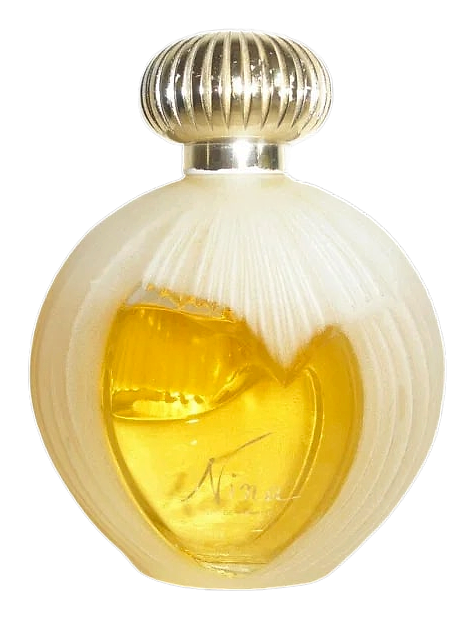
Released in 1987 under the Nina Ricci name, Nina sits alongside the house's more celebrated compositions, a quieter sibling to L'Air du Temps. The fragrance was composed by Christian Vacchiano, a perfumer whose career spanned decades of French composition and collaborations with multiple houses. This isn't the bright cologne-style freshness of an eau de cologne, nor the solemn opulence of classical perfumery. It's a modern aldehyde floral designed for a woman who wants polish without formality. The composition opens with a burst of aldehydes that catch the light like clean glass, with bergamot and lemon lending a sharpened brightness and peach smoothing the edges into something almost edible.
What makes Nina interesting isn't any single note. It's the negotiation between aldehydes and civet, a meeting of two polarities in classical perfumery. Aldehydes give that washed-clean sparkle, a sense of light bouncing off porcelain, while civet grounds everything in something darker, warmer, animal. Iris bridges the gap, powdery and cool at the same time. The chypre bones, moss and patchouli, hold the aldehydes in place so they don't float away. It reads as clean but never sterile, warm but never heavy.
The evolution
The first ten minutes belong to the aldehydes, clean and bright, almost soapy in the way light aldehydes can be. Bergamot and lemon register as cold clarity, peach softening just enough to keep it from feeling clinical. Around the fifteen-minute mark, the heart arrives without announcement. Iris is the dominant voice, powdery and cool, but ylang-ylang pulls warmth underneath it. Jasmine and rose barely peek through, they're present but never solo. Violet adds a slightly candied sweetness. An hour in, the green facets fade. Basil disappears. Laurel lingers as a shadow, a faint coolness at the edges. As the composition develops, the base settles into place: sandalwood and musk form a soft bed, patchouli adds depth without going earthy, moss grounds it in classic chypre territory. Civet is the wild card. It doesn't roar. It hums underneath, adding a warmth that reads almost like skin.
Cultural impact
Nina occupies a particular place in 1980s perfumery, released in 1987 as an aldehyde composition at a time when the note had become less common in mainstream releases. Within the Nina Ricci line, it sits alongside L'Air du Temps, offering a different kind of statement. Wearers who connect with it tend to be drawn to classical chypre structure with a modern softness, the kind of composition that rewards patience rather than first-spray impressions. The fragrance offers something distinct from the louder, sweeter compositions that proliferated in the decade, instead embracing a quieter kind of sophistication.