The Story
Why it exists.
The beginning
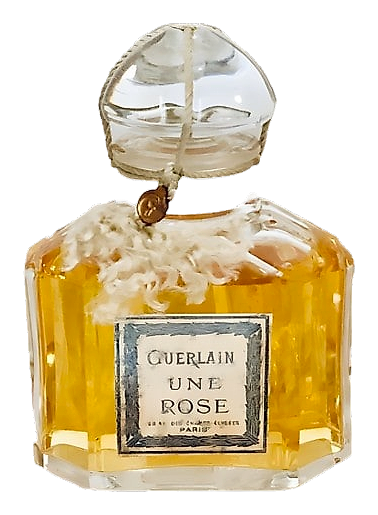
In 1908, Jacques Guerlain composed Une Rose, a fragrance that took the house's devotion to raw materials and pushed it toward something almost architectural in its density. The name is simple, almost defiant: one rose. But nothing about this composition is singular. It's a rose surrounded by a court of white florals, green herbs, and deep balsamic resins, layered and intertwined until the whole reads less like a single flower and more like a bouquet pressed into velvet. Each note shoulders weight: the acacia and neroli lift the top with brightness, the lilac and hyacinth lend their cool green edges, the violet and clove warm the middle, and the oakmoss, patchouli, tolu balsam, and benzoin anchor the whole thing in something rich and resinous.
What makes Une Rose unusual is its refusal to be only a soliflore despite its name. The rose is unmistakable, but it's framed by violet, jasmine, tuberose, and a surprising thread of clove and carnation that pushes the heart toward spice. The base is where things get serious: oakmoss and patchouli give it depth and soil, while civet and orris add an animalic warmth that modern rose fragrances rarely attempt. This is a rose with weight, with history, with a slight scandal.
The evolution
The opening is almost indecent in its brightness. Acacia, neroli, and sweet orange hit together like light through a window, with lilac and hyacinth adding a green-soapy edge. It's fleeting, deliberate, a curtain-raiser. Soon after, the rose arrives properly, escorted by violet and a thread of clove that reads more as warmth than spice. The jasmine and tuberose pad the silhouette, giving the floral heart its rounded, almost creamy shape. As the composition settles, the base begins to assert itself. Oakmoss and patchouli darken the edges, while civet adds something furred and warm, the suggestion of skin rather than flower. The rose deepens with wear, going almost powdery as tolu balsam and benzoin sweeten what remains, rooted in sandalwood and cedar that lend a quiet woody undertone.
Cultural impact
Une Rose sits in an unusual place in the Guerlain catalogue: a composition that rewards attention and resists easy summary. It carries a sensibility that feels removed from current fashion, closer to an older idea of what a floral perfume can be when it refuses to behave as a single flower. The fragrance treats rose not as a marketing line but as a centerpiece around which everything else gathers: the green herbs sharpen it, the white florals round it, the balsamic resins darken it into something that lasts.
The House
GuerlainGuerlain stands as one of the oldest and most revered perfume houses in the world, founded in Paris in 1828 by Pierre-François-Pascal Guerlain. What began as a boutique on rue de Rivoli quickly became the preferred destination for Parisian society, attracting dandies and elegant women who sought custom-crafted fragrances. The house's influence grew to such heights that Guerlain earned the title of Official Perfumer to Napoleon III after presenting Eau de Cologne Impériale to Empress Eugénie as a wedding gift in 1853. This royal patronage marked the beginning of Guerlain's enduring association with European aristocracy, as the house went on to create fragrances for Queen Victoria and Queen Isabella II of Spain. Today, under the creative direction of Thierry Wasser, the fifth-generation perfumer, Guerlain continues to shape the landscape of fine fragrance with a portfolio spanning over 1,100 olfactory creations. The house remains headquartered at its legendary Champs-Élysées mansion, a historic monument that anchors Guerlain's position at the intersection of heritage and contemporary luxury.
The Creator
Jacques GuerlainJacques was among the first perfumers to work seriously with synthetic ingredients alongside naturals, publishing on essential oils with chemist Justin Dupont and experimenting with perfuming ink. His technical approach was precise: volume measurements for liquids, careful wei…