
The Story
Why it exists.
The beginning
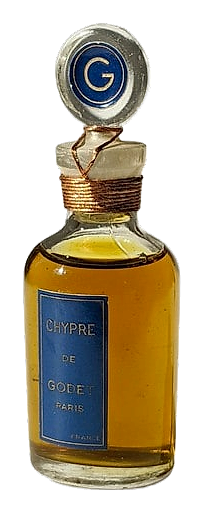
Chypre arrived in 1908 as a confident entry from Julien-Joseph Godet, a perfumer working in the French tradition. The name carried weight. Chypre referred to a recognized perfumery structure built around mossy-woody character, with warm bases, floral hearts, and fresh openings drawing on Mediterranean ingredients. Godet wasn't working in a vacuum; he was engaging with a language that already existed in fine fragrance, then writing his own sentence within it. The fragrance reads as an attempt to show what careful composition within that established grammar could achieve, every note placed with the kind of deliberation that separates a house perfume from a trend-driven release.
The note pyramid reads like a chypre textbook filtered through Godet's particular sensibilities. Coumarin opens the composition alongside bergamot and lemon, giving the citrus a sweet, haylike undertone. Galbanum drives into the heart with that bitter green sting, a note that smells like crushed leaves and cold morning air, bracing against the sweeter elements above it. The base leans on incense and benzoin, choosing those resins for their devotional, almost smoky warmth, qualities that let the drydown feel contemplative rather than heavy.
The evolution
The first hour is almost edible. Bergamot and lemon arrive bright, but the coumarin underneath them pulls the sweetness forward fast, like the smell of warm tonka before you see the beans. There's a candy-like quality, almost confectionery, that one vintage source describes as a candy-sweet citrus opening. By the second hour, the lavender, jasmine, and rose have settled in with the galbanum, and the composition shifts from citrus to floral-green with a herbal thread running through it. The galbanum does the heavy lifting in the transition, pulling the brightness down into something cooler and more vegetal. Then, somewhere around the middle of the wear, the incense and benzoin arrive with the oakmoss, and the whole thing turns warm and balsamic. That drydown is where the fragrance finds its deepest voice.
Cultural impact
Chypre (1908) shares a contemplative, balsamic warmth with Caron's Nuit de Noël, another pre-war classic that wears close and reverent. Both fragrances lean into the mossy-woody tradition with a devotional quietness rather than theatrical projection. Collectors who appreciate discontinued house formulas and vintage extraits often find their way to this one, drawn by its Baccarat-flacon provenance and the kind of patina that only age gives a composition.