The Story
Why it exists.
The beginning
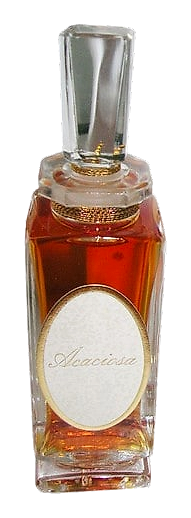
In 1924, Acaciosa arrived as one of Caron's early parfum-concentration florals, composed by the self-taught perfumer Ernest Daltroff at a house already known for opulent, boundary-pushing compositions. Daltroff approached his craft with a near-obsessive focus on raw materials, treating each one as a voice that needed balancing rather than a note that simply needed placing. He layered jasmine, orange blossom, and ylang-ylang into a bouquet so dense it demanded attention, the white florals piling on top of one another until the accord took on a weight and substance rarely seen in commercial perfumery of the era. Ylang-ylang brought its sun-warmed, custard-like fullness, while orange blossom contributed a sharper, almost metallic honey. Jasmine anchored everything with its animalic density.
The heart of the composition carries remarkable structure. Daltroff built the central accord around sandalwood, a material prized for its creamy, lactonic depth and its ability to anchor volatile florals without dulling them. Pineapple was the daring choice, a fruity note that could easily tilt a white floral accord toward something juvenile or syrupy. Here it functions as a brightening agent, slicing through the jasmine's indolic density and giving the composition its almost edible sweetness.
The evolution
Acaciosa opens with a generous pour of orange blossom and jasmine, the white florals bright and almost sunlit, lifted by ylang-ylang's custard-like fullness. The ylang reads as slightly banana-skin sweet at first contact, a tropical undertone that adds volume to the jasmine's indolic density before receding into the bouquet. Within minutes, the composition settles into its heart phase, the orange blossom mellowing toward something honeyed and the jasmine deepening into its animalic register. As the hours pass, the white florals blur into one another, losing their individual edges and merging into a creamy, almost waxy accord that sits closer to the skin. What remains after a full day's wear is a quiet, soapy trace, the kind of faded floral that clings to a wool collar or a cashmere scarf and keeps releasing faint tendrils of scent long after the wearer has stopped noticing it.
Cultural impact
Acaciosa sits among Caron's early parfum-concentration florals, the kind of composition that defined the house's reputation during its first decades of operation. It belongs to a tradition of dense, unapologetically bold white florals built to announce themselves from across a room rather than whisper from a wrist. Wearers who gravitate toward vintage-style indolic jasmine, thick with orange blossom and warmed by sandalwood, tend to find a kindred spirit here. The pineapple note adds an unexpected brightness that keeps the composition from veering into pure solemnity, giving it a personality that feels lively rather than funereal.