
The Story
Why it exists.
The beginning
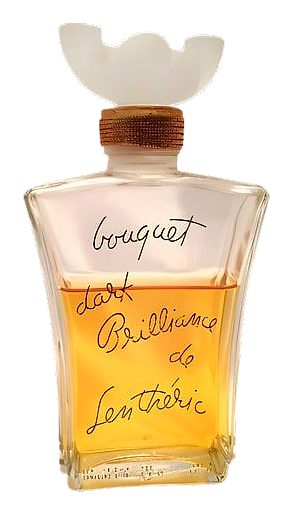
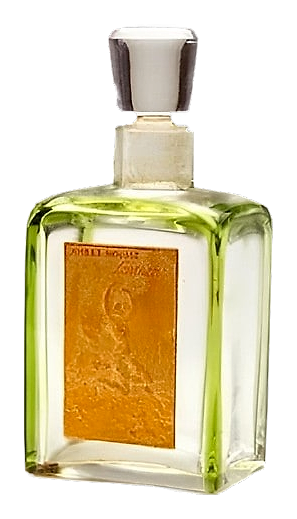
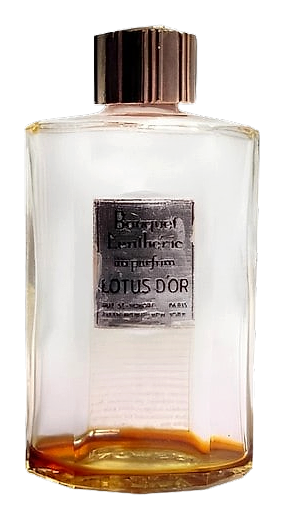
1924 was the year Lentheric crossed a threshold. The Paris house had spent decades composing personal scents for individual clients. Now newly reorganized, the firm was ready to put its private language into bottles anyone could reach for. Lotus D'Or was part of that first public statement, part of the Bouquet Lenthéric line that announced the house to a wider audience. The name means Golden Lotus, and the composition takes that single flower as its architecture, a focused meditation rather than a crowded florist's tray. A perfume built around a single water flower with an ozonic sheen was a deliberate act of restraint, a choice to let one botanical speak rather than compete for attention against richer, denser compositions.
The ozonic accord was the interesting move. In 1924, the perfumer's palette for that sensation was limited: a few aldehydes and the mineral suggestion of certain green leaf notes. Constructing a scent that reads as cool air and sunlit water around a lotus center required careful anchoring, because ozonic notes can vanish on skin within minutes without a substantial base to hold them.
The evolution
The opening arrives as if from another room. A cold, watery lift, some aldehyde-edged brightness that reads as ozone or the first breath after rain, then a slow reveal of orange blossom and Cassie, the latter giving a faint waxy-green edge that keeps things from going purely sweet. The heart takes shape gradually, without ceremony. Tuberose shows up but stays behind a gauze of jasmine and heliotrope, suggesting rather than declaring. Violet leaves add a cooler impression, and the whole thing settles into a creamy, slightly powdered white floral that holds steady through the middle of the wear. There is no dramatic shift here, no leather suddenly arriving to change the room, no incense swinging in from another decade. The drydown is where the composition earns its name.
Cultural impact
Lotus D'Or belongs to the Bouquet Lenthéric line that defined the house's interwar identity, a small constellation of bottled scents released to introduce the firm to a wider audience. Within fragrance history, the composition reads as an early statement in the sheer, single-flower register, the kind of restrained soliflore built on a watery, ozonic top note over a white-floral heart, an approach still uncommon at the moment of its release.