The Story
Why it exists.
The beginning
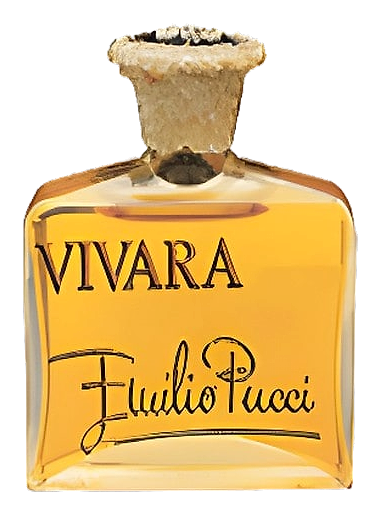
Vivara arrived in 1965, named for the crescent-shaped island off the Gulf of Naples. Emilio Pucci commissioned Michel Hy to translate something essentially Italian into scent. The 1965 brief was clear: this was for the modern woman, rebellious in her choices. Hy reached for green chypre architecture and filled it with the warmth of a Mediterranean afternoon. What makes Vivara distinct is its restraint in the opening. Where many 1965 fragrances announced themselves loudly, Vivara opens with a studied brightness, aldehydes and bergamot that feel almost mineral before the florals arrive. The island inspiration shows not in any literal coastal reference but in the composition's relationship to light: sharp at the top, warm at the base, with nowhere to hide.
The pyramid includes eight base materials: frankincense, benzoin, and vetiver alongside the expected oakmoss and leather. This layering creates the fragrance's characteristic arc: rather than a sharp transition from top to drydown, Vivara moves through overlapping waves of floral and resin that take time to fully resolve. The carnation-peach combination in the heart is particularly effective. Surrounded by carnation's spice and ylang-ylang's cream, the peach becomes something more complex, a sweetness that doesn't announce itself.
The evolution
The aldehydes arrive first, bright and slightly waxy, the smell of light, clean and piercing. Bergamot and galbanum follow within minutes, the green notes lifting everything so it doesn't feel heavy despite the density underneath. The peach appears here too, softening the edges of the spice accord that includes carnation. Then the florals arrive. Jasmine and ylang-ylang form a creamy middle that pushes the peach into the background, replacing brightness with warmth. Rose adds a flicker of sweetness, lily of the valley a whisper of something almost aquatic beneath the cream. This is the phase that lasts longest, the heart phase holding the composition in its most complex and evolving state. The drydown is where Vivara earns its reputation. Leather, oakmoss, and patchouli form a chypre foundation that settles close to the skin.
Cultural impact
Vivara occupies an interesting position among 1960s chypres, distinctive for its layered drydown and the way it ages on skin. It offered the structure of a classical chypre softened by warmth, a fragrance that rewarded patience as it revealed its complexities over hours of wear. The composition stands apart from the simpler floral interpretations that characterized much of the decade's women's fragrance, suggesting a more sophisticated approach to scent construction that looked toward the evolving tastes of the late 1960s.