
The Story
Why it exists.
The beginning
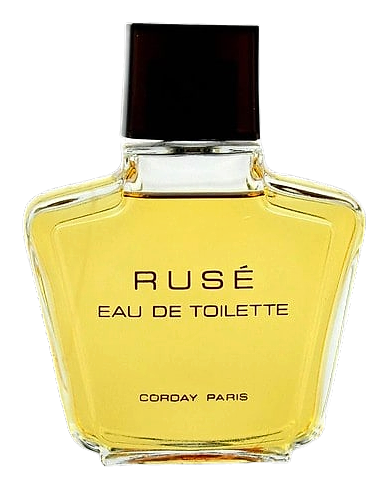
The name says everything. Rusé means cunning in French, a crafty, knowing quality that the 1966 composition wears like a second skin. By the mid-60s, Corday had spent four decades building quietly self-possessed fragrances that didn't announce themselves. Rusé arrived with the green florals the era demanded, but beneath the Narcissus and the geranium lay something the house had been moving toward: a chypre base that didn't soften its animalic edges. The name was the perfumer's quiet confession. This was designed to deceive, to smell prettier than it was.
What makes the structure unusual is the persistence of green. In most chypres, the green notes lead and fade within the first hour, ceding ground to the florals and then the moss. In Rusé, Galbanum and the green note accord hold on through the heart, threading through geranium and iris like a current beneath a river. The leather and civet arrive late, they're not the opening statement but the revelation. By the time the base settles, the composition has performed its trick: you smell green florals, then you smell the fragrance you thought you were wearing, then you smell what it actually is. The pyramid is a ruse in itself. Dense top, dense heart, dense base, this isn't a light EDT structure.
The evolution
The opening hits sharp and immediate. Green notes and Narcissus arrive together, Narcissus being the rare material that bridges the gap between fresh-cut stems and creamy floral, a waxy sweetness undercut by something almost green and bitter. Bergamot adds brightness without warmth. Petitgrain gives the whole thing a slightly bark-like undertone. Within 15 minutes, the florals begin to assert themselves. Geranium and Iris arrive first, geranium adding a rose-adjacent warmth with a green, slightly sharp edge, iris bringing powder and a cool violet character that elevates the composition into something more refined. Rose and Jasmine appear but don't dominate. They're part of a larger floral chorus that includes Hyacinth, Lily of the Valley, and Mimosa, with Lemon Verbena cutting through the density with a lemony-green lift. The green note from the opening never fully disappears, it deepens and integrates, becoming part of the floral texture rather than a separate layer.
Cultural impact
Rusé occupies a specific corner of the vintage fragrance world, green chypres from the mid-century era. The composition's defining quality is its refusal to soften the animalic base. Modern reformulations of classic chypres often reduce or remove civet and restrict oakmoss, fundamentally altering the drydown. Rusé, particularly in its Parfum concentration, preserves that raw chypre signature. For collectors of green chypres who appreciate the genre's full complexity, the green-citrus opening, the dense floral heart, the mossy-animalic base, this is a reference point worth knowing.