
The Story
Why it exists.
The beginning
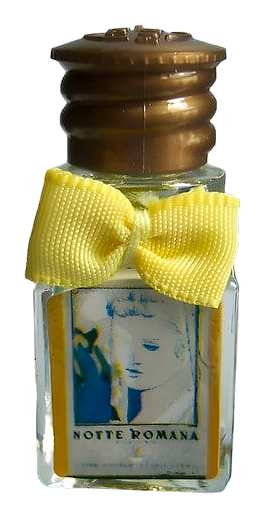
Notte Romana arrived in 1939, carrying a name that translates to Roman Night and conjures candlelight, marble, the particular stillness of an Italian evening when the churches close and the streets hold onto the warmth of the day. It is a fragrance built for that hour. The opening is a green-powder crack, sharp and vegetal, like crushed stems underfoot, before the white florals settle in and take on the quiet gravity of an altar arrangement. White lilies rise with a waxy, almost humid sweetness, the kind that reads devotional rather than decorative, as if the petals were arranged for someone kneeling rather than for someone passing by. Iris threads through as a cool, suede-like haze, giving the composition a metallic hush that keeps the sweetness from spilling over.
The composition leans on a specific pairing that defines it: iris and galbanum as the opening green-powder crack, then white lily and lotus as the devotional heart, with vanilla and tonka anchoring the drydown. Iris gives the metallic, cool, almost suede-like texture that has long been a signature of Italian perfumery, that cool purple root rendered as vapor rather than dust. Galbanum adds that bitter green stem snap, the raw vegetal bite of a leaf torn fresh from the plant. Together they keep the lilies from reading too sweet, too bridal, too obvious.
The evolution
Notte Romana arrived in 1939, a date that places it firmly within the canon of mid-century Italian floral perfumery. The original architecture leans on galbanum, iris, and white lily in the opening, moves through a heart of lily of the valley, lotus, and rose, and settles into a base of musk, sandalwood, tonka bean, and vanilla that reads as warm powder rather than sweetness. The opening is crisp and bracing, the galbanum cutting through with a sharp green bitterness while iris floats just above it, cool and mineral, like a shadow passing across stone. Within the first thirty minutes the white florals bloom outward, the lily arriving with a dense, almost waxy presence that softens the green edge, and the rose peeks through quietly, lending a faint fruitiness beneath the petals. As the hours pass the composition surrenders its crispness.
Cultural impact
Notte Romana sits comfortably in the company of other white floral classics, the kind of compositions that treat the wearer as someone already composed upon entering a room. It reads as old-world Italian rather than modern, the scent of candlelight on plaster rather than glass and steel under fluorescent light. The opening is unmistakably green, the galbanum sharp enough to clear a room, before the powder settles in like dust motes caught in a shaft of late afternoon sun. For anyone drawn to vintage Italian perfumery, this functions as a reference point, the kind of bottle that anchors a collection rather than simply adding to it.