The Story
Why it exists.
The beginning
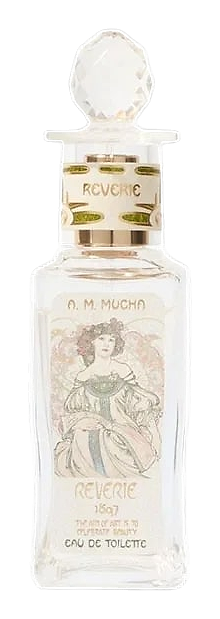
Reverie 1897 draws its name and its mood from Alphonse Mucha's 1897 painting "Reverie," an Art Nouveau work rooted in the suspended state between waking and dreaming. Released in 2026, the fragrance is Mucha's attempt to bottle that quiet, half-lit feeling. The concept is straightforward: take the visual softness of Mucha's compositions and translate it into something you wear on skin. The composition leans floral-aldehyde, a classic architecture that suits the era it references. Rather than chasing trends, it reaches back to a structure that defined late-19th-century perfumery. The result reads as an attempt to capture the painting itself in scent form, a portrait that wears close to the body rather than projecting loudly across a room.
The choice of Japanese shiso in the heart is the unexpected move. It's a green, herbal note with a faintly metallic edge, one you rarely see paired with heliotrope and jasmine in a classical aldehyde framework. The shiso introduces a cool, almost minty clarity that lifts the jasmine and keeps the whole accord from collapsing into sweetness. It threads through the composition like a quiet counterpoint, adding an herbal sharpness that prevents the florals from becoming monochromatic.
The evolution
The first fifteen minutes are all aldehyde sparkle, a soapy, effervescent lift that reads almost like fizzy mineral water. Bergamot and tangerine barely register as distinct citrus, more like a suggestion of brightness underneath the chemical shimmer. By the thirty-minute mark, the aldehydes recede and heliotrope takes over, that distinctive almond-cherry-powder accord that smells less like a flower and more like the memory of one. Jasmine hovers at the edges, white and a little waxy, while the shiso adds a green thread you feel more than smell. The middle phase is where the fragrance lives longest, a soft, slightly sweet, vaguely floral cloud that stays consistent for two to three hours. Once the base settles, the sandalwood and vanilla emerge together, creamy and warm, with the dry woods component giving the whole thing a hazy, unfocused quality.
Cultural impact
Reverie 1897 arrives in 2026 as a fragrance directly inspired by a specific Alphonse Mucha painting from 1897, the work titled "Reverie." The composition leans on a floral-aldehyde skeleton, a structure associated with late-19th-century perfumery and the kind of formal, composed fragrances produced in that era. By naming the launch after a single dated painting rather than a broader concept, the project signals an attention to a particular source, grounding the scent in a specific visual reference rather than a generalized aesthetic mood.