
The Story
Why it exists.
The beginning
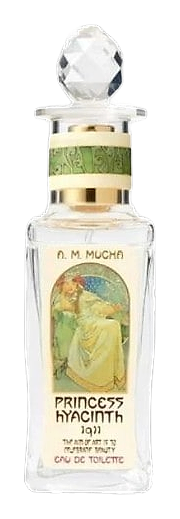
Princess Hyacinth takes its name from a real fairy tale opera, premiered in 1911 at the National Theatre in Prague, with a libretto by Ladislav Novák. The title alone opens a window into Mucha's world, where mythology, theatre, and ornamental beauty cross into one another with surprising ease. The fragrance draws from the same well: a single bloom that carries a royal name, wrapped in the atmosphere of a Belle Époque stage. The juice itself plays with tension between green and sweet, between the living scent of a cut stem and the warmer, almost edible undertone that fig brings to the composition. Bergamot and blackcurrant lift the opening with a brisk, tart brightness, while a clean musk base keeps the whole thing close to skin rather than letting it float off into decoration.
The composition is built around a single flower and a single fruit. Hyacinth sits in the heart, fig splitting the top and base. Fig nectar in the drydown keeps the sweetness from ever fully settling, holding it in a kind of permanent bloom. Blackcurrant and bergamot pull the opening into something brighter and more tart than a typical floral fruity, and a clean musk base keeps the whole thing skin-close rather than decorative.
The evolution
The opening belongs to blackcurrant and bergamot, tart and almost effervescent, with fig sitting underneath like a quiet hum. As the composition develops, the hyacinth arrives, green and stem-like, and the fruit recedes just enough to let that floral sharpness lead. The shift from top to heart feels almost like turning a page: the brightness of the citrus and cassis gives way to something more vegetal and slightly cool, the way a bouquet changes once you've been standing near it for a while. Eventually the composition moves into its later phase. The fig returns as fig nectar, thicker and warmer, while musk takes over the base, wrapping the floral close to skin. The drydown stays there for hours, a soft, sweet, slightly musky residue that lingers on fabric into the next morning. On a scarf, it outlasts a full workday, holding its shape even as it softens.
Cultural impact
Within the small world of art-house perfumery, Mucha occupies an unusual position. Princess Hyacinth 1911 is named after a fairy tale opera that premiered in 1911 at the National Theatre in Prague, with a libretto by Ladislav Novák, and the fragrance borrows its mood from that same period of theatrical mythology and decorative imagination. The release sits naturally beside a Mucha print, the kind of object that earns its place on a shelf through provenance as much as through scent.