
The Story
Why it exists.
The beginning
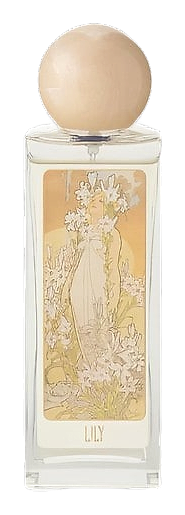
Lily belongs to a fragrance line that draws directly from the artwork of Alphonse Mucha, the Czech Art Nouveau painter whose flowing compositions of women and ornamental botanicals defined a visual era. Mucha's art treats flowers as more than decorative elements; they are personalities, portraits rendered in petals and curves, each one holding a distinct emotional register. The fragrance adopts that same logic, naming its scent after the lily not as a generic white bloom but as a character. The actual note list reads like a careful selection of materials that speak to each other: bergamot and blackcurrant in the top, jasmine, lily, and ylang-ylang forming the floral heart, and musk and vanilla anchoring the base.
What makes Lily interesting is the tension between its fruit opening and its floral heart. Bergamot and blackcurrant arrive first with a brightness that feels almost edible, a tart-sweet lift that suggests something vivid and alert. Then the jasmine, lily, and ylang-ylang take over, and the composition shifts toward something creamier and more languid. Ylang-ylang in particular brings a banana-like richness that pushes against the cleaner jasmine, creating a friction between two floral personalities that want different textures.
The evolution
The first hour reads bright and almost edible. Bergamot arrives with its familiar citric snap, sharp but rounded, and the blackcurrant layers underneath it with a darker fruit sweetness, the kind that suggests cassis rather than candy. Within twenty minutes the jasmine begins to surface, indolic and warm rather than cool, the way jasmine smells at dusk rather than in a cold morning garden. The ylang-ylang moves in alongside it, bringing that creamy, almost tropical density, while the lily note hovers between the two, holding the more assertive florals together. By the third hour the vanilla has settled in fully, taking the sharp fruit edge off without turning the composition into dessert. The musk creates a clean, slightly skin-like base that keeps the sweetness from cloying, reading more like warmth than like sugar.
Cultural impact
Lily occupies an interesting position within the broader category of white and yellow florals, a genre with deep roots in both classical perfumery and contemporary niche fragrance. Where many florals lean either clean and soapy or lush and indolic, Lily pulls toward something more textured, a composition that includes jasmine and ylang-ylang alongside a fruity opening that keeps the florals from feeling austere. The addition of vanilla and musk in the base gives it a softness that distinguishes it from sharper green florals or more austere soliflores.