
The Story
Why it exists.
The beginning
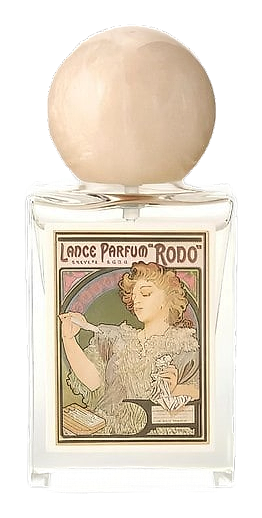
In 1896, Alphonse Mucha painted a woman for Lance Parfum Rodo. She appears doubly haloed, her radiating tresses set against a rounded architectural backdrop, her face turned just enough to hold the viewer's attention. Her expression is composed, present, caught in a single suspended moment rather than mid-motion. The poster became a defining image of its period, a fixed point in the visual record of turn-of-the-century poster art. More than 125 years later, the MUCHA fragrance house was launched, marketed by MASH Group. Rodo, the Eau de Toilette, takes its name directly from that 1896 commission. It is not a reproduction of the original Rodo perfume, which was produced by the Société des Usines Chimiques du Rhône in Lyon.
The structure here is worth noticing. Orange and pear do the opening work, bright and clean, but they make way for a heart that is almost entirely floral: osmanthus lending its apricot-skin warmth, freesia adding a cool green lift, and rose carrying the center. The base is where this composition departs from the usual powdery floral template. Patchouli and musk, no vanilla, no sandalwood. That choice keeps the drydown earthy and alive instead of sweet and sleepy. It is a rose composition that refuses to behave like one.
The evolution
The first ten minutes are the brightness: orange zest, the cool sweetness of pear, almost like biting into fruit still cold from the fridge. Then the florals arrive, and they arrive together rather than in sequence. Freesia gives a crisp, almost metallic green edge. Osmanthus adds something warmer, slightly fruity, like the skin of a ripe apricot held close. Rose sits at the center, not shy, not screaming, present without dominating. This heart phase holds for a good two to three hours, steady and composed. The shift into drydown is gradual. Patchouli surfaces quietly, bringing an earthy, slightly damp quality that sits beneath the fading florals. Musk comes last, clean and close to the skin. By the fifth hour, what remains is a soft, warm, slightly woody musk that lingers on fabric the next morning. Not loud. Not gone. Just settled.
Cultural impact
Rodo sits at the intersection of art history and contemporary fragrance. By naming a release after Mucha's 1896 poster, the house stakes out a position that few fragrance lines attempt: that a painting can be a starting point for scent, not just a label applied to a bottle. For collectors who treat fragrance as an extension of visual culture, Rodo offers something most launches do not, a direct connection to a specific artwork that can be traced, cited, and studied.