The Story
Why it exists.
The beginning
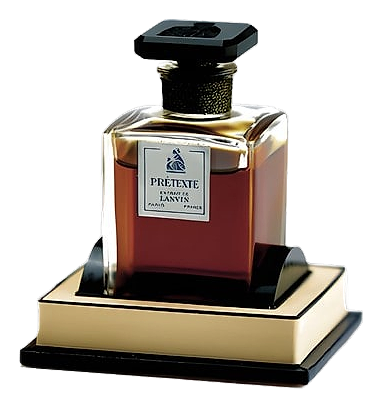
André Fraysse created Prétexte for Lanvin in 1937, during an era when the house was building its perfumery legacy alongside its couture empire. Fraysse had been with Lanvin since the house's first fragrance in 1925, and Prétexte represented his vision of what a Lanvin woman could smell like when no one was looking. The name itself, pretext, an excuse, suggests something deliberate: a reason to exist in a particular world of powder and warmth and animal presence.
What makes Prétexte structurally unusual is the combination of aldehydes with heavy animalic base notes, civet and castoreum especially. Aldehydes typically appear in lighter, more abstract florals. Here they sit atop a foundation that is deeply physical, even visceral. The opoponax in the heart acts as a bridge between these worlds: sweet, balsamic, slightly vanillic, it softens the animalic notes that dominate the drydown without hiding them. The hay note is unusual too, lending a warm, granular quality that grounds the florals in something almost rustic.
The evolution
The aldehydes announce themselves immediately, bright, waxy, sparkling. Within minutes, the narcissus introduces a cool, green note that tempers the brightness, while bergamot adds a fleeting citrus lift. The first hour belongs to the heart: rose and carnation lift the opoponax into something powdery and warm, with iris adding its violet-like sweetness and hawthorn providing a delicate, almost honeyed quality. Then the base takes over, and this is where Prétexte becomes itself. The civet arrives like a slow exhale, animalic, sweaty, intimate. Leather, castoreum, oakmoss build a darkness that is almost confrontational in its honesty. But the warmth holds: sandalwood, amber, tonka bean, patchouli, vetiver, each one present, each one lasting. This base doesn't fade. It lingers for hours, often into the next day on fabric.
Cultural impact
Prétexte occupies a specific corner of fragrance history, vintage French extraits built for presence. Its aldehydic-chypre structure places it in conversation with landmark fragrances of the era, yet its animalic warmth sets it apart. Discontinued in 1969, it has become a quiet grail for those who remember, and a discovery for those willing to seek out what vintage perfumery once offered without apology.