The Story
Why it exists.
The beginning
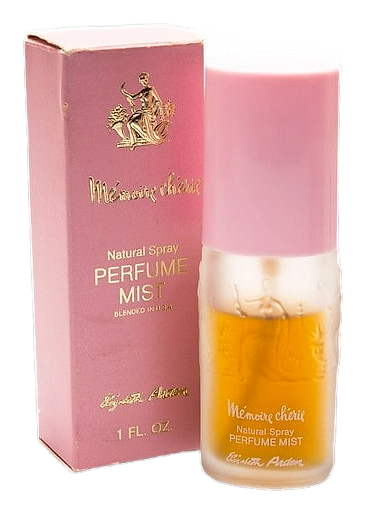
Memoire Cherie arrived in 1956, a moment when American women were stepping into new public roles and looking for fragrance to match. Elizabeth Arden had built her empire on the premise that beauty was self-made, that elegance could be learned, purchased, perfected. This scent fits that philosophy exactly: a floral aldehydic built to last a full day, projecting the kind of composure that doesn't need announcing. The name itself, Cherie, dear one, a term of endearment, suggests something intimate worn outward, not a statement made for others. It was composed as a powdery aldehydic in the grand tradition, but with enough honey and carnation in the heart to keep it from feeling like a museum piece.
Aldehydes are the signature move here, those waxy, effervescent molecules that can make a fragrance feel like it's glowing from within. In lesser hands, they read sharp and medicinal. In Memoire Cherie, they bloom warm and powdery, lifting the orange blossom and apricot into something that feels candlelit rather than clinical. The honey and carnation in the heart are what make this unusual: a richness that borders on autumnal, a sweetness that doesn't apologize for itself. Combined with the mossy, animalic base, civet, opoponax, leather, it has the structure of a chypre but the warmth of a memory.
The evolution
It opens aldehydic, yes, that distinctive waxy sparkle that defines the genre, but the bergamot and mandarin keep it from feeling cold. Within minutes, the orange blossom and neroli arrive, sweet and slightly bitter, like the air outside a church in late summer. The heart is where this fragrance earns its name. The honey doesn't smell like a beehive, it smells like the idea of honey, condensed and golden, wrapped around carnation's spice and ylang-ylang's cream. This phase lasts longest on most skin types, a full powdery bloom that refuses to rush. Then the base arrives: oakmoss and vetiver, amber warmth, and civet, that animalic note that gives skin its own scent again. By hour six, it's skin and powder and something faintly sweet that stays close.
Cultural impact
Memoire Cherie won the Coupe D'Or award from the Comite du Bon Gout Francais, recognition that placed it among the significant aldehydic florals of its era, alongside compositions from the great French houses. For wearers who appreciate powdery florals, it occupies a niche between the sharp aldehydic classics and the sweeter orientals of the period. The civet note remains divisive, those who love it describe it as the quality that makes skin smell like skin again, while others find it too animalic. This polarization is characteristic of the aldehydic chypre genre, a style that has cycled in and out of fashion but retains devoted followers who appreciate its complexity and longevity.