The Story
Why it exists.
The beginning
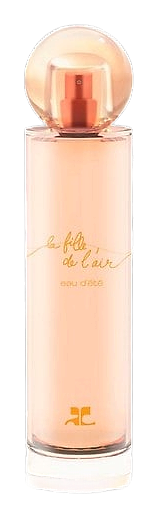
Courrèges released La Fille de l'Air in 2015, a composition centered on orange blossom with clear, sharp lines. Then summer 2016 brought Eau d'Été, a limited edition reinterpretation by perfumer Fabrice Pellegrin. The exercise was one of recalibration: take the original's blueprint and tune it for warmer days. The bottle shifts to pastel shades, replacing the original orange presentation. The juice itself uses less alcohol than a standard formulation, which lends a softer diffusion on skin from the first spray onward. What stays constant is the architectural clarity of the original; what changes is how that clarity breathes in heat. Notes are chosen to hold up when temperatures climb, with Calabrian bergamot and an ozonic accord entering the picture alongside the signature orange blossom.
Restraint defines this release. Pellegrin didn't stack new headliners on top of the original concept. He pared things back. Calabrian bergamot enters with a bright, almost transparent quality, one that reads more like light than like fruit. An ozonic accord arrives at the same moment, lifting the opening into something that recalls moving air rather than a static bottle on a shelf. Then orange blossom carries the heart, deliberately thinned from the density of the original so it sits comfortably against warmer skin.
The evolution
The first fifteen minutes feel almost edible. Calabrian bergamot cuts through with a bright citrus snap, and the ozonic accord lifts it higher, turning the opening into something that smells like cold water on warm skin. There's a crispness to this phase that feels engineered for the moment you step out of shade and into direct sun. Then orange blossom arrives, but gently. Not the heady, indolic sweetness you get in denser florals. Here it's thinned out, almost translucent, the way real orange blossom smells at noon when the sun has burned off the morning's heavier oils. The warmth reads as suggestion rather than statement, a soft radiance that holds its distance from the skin. After about an hour, the cedar grounds things. It doesn't arrive loudly. It just stops the fragrance from floating away entirely, anchoring the composition in something faintly woody and dry.
Cultural impact
La Fille de l'Air Eau d'Été arrived as a limited summer release and passed through quickly, which has shaped the way it's discussed today. Because it was never a permanent addition to the lineup, it carries the particular appeal of fragrances that existed briefly and then disappeared from counters. Its combination of ozonic freshness and orange blossom reads as a particular kind of summer statement: airy where many summer releases lean tropical, clean where others lean sweet.