The Story
Why it exists.
The beginning
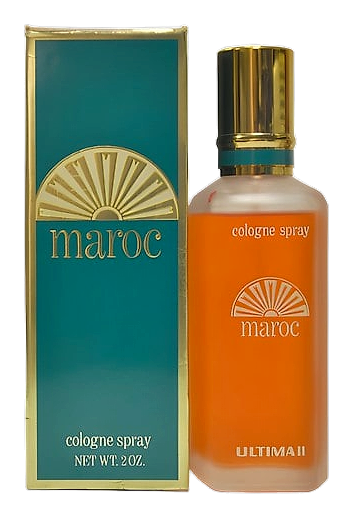
Maroc arrived in 1985 under the Ultima II label, the fragrance wing of Charles Revson. Its inspiration was specific and almost romantic: the moschata, a wild musk rose that grows along the Mediterranean coast of Morocco and blooms in September sunlight, then keeps releasing its scent long after dark. That dual life, sunlit and nocturnal, floral and faintly dirty, gave the perfumers their brief. Build something that smells like the flowers themselves, lush and warm, but with the shadow that clings to them once the light goes. The rose here is rendered with botanical fidelity, the petals warm and alive on skin, not the candied, jammy rose of sweeter compositions.
What makes Maroc unusual is how fully it commits to the old-school chypre skeleton. The aldehydes and honey open is almost decorative, a sparkle thrown over the top, but underneath sits a mossy-patchouli foundation seasoned with civet and ambergris. The roses aren't pretty for pretty's sake. The Moroccan rose and white rose are dosed to read slightly sour, slightly jam-stained, the way real crushed petals do. It takes the chypre's herbal rigor seriously enough to let the animalic notes breathe.
The evolution
The first thirty minutes are loud. Aldehydes flash, the honey thickens, coriander and bergamot cut through like cold air hitting warm skin. It smells expensive and a little aggressive, the kind of opening that announces rather than suggests. Somewhere around the one-hour mark the aldehydes pull back and the roses take over the foreground. Not delicate tea-rose, either. These roses are saturated, edged with geranium's green sharpness, and they sit on a bed of patchouli and palisander rosewood that gives the whole heart a reddish, woody warmth. The civet starts to surface in the second hour, not as a shock but as a slow turn toward something skin-like and lived-in. By hour four you're in the drydown proper: oakmoss and orris root, the vetiver and musk and ambergris all settled into a mossy, faintly powdery base that clings to fabric and hair for the rest of the day. The next morning, on a scarf or a coat collar, it still smells faintly of rose and something animal, quieter now, but unmistakably there.
Cultural impact
Maroc wears with a mossy, rose-heavy profile that gives it its own line on the shelf, bold and unapologetically animalic in a way that sets it apart from softer fare. Wearers who find it tend to keep it, layering it through fall and winter when the damp, earthy notes get to breathe against cooler air. The chypre structure holds up beautifully in cold weather, the oakmoss and patchouli reading richer when the temperature drops, and the rose deepening into something closer to preserved petals than fresh blooms.