The Story
Why it exists.
The beginning
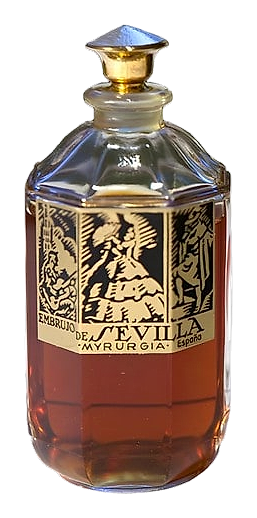
The name says everything. Embrujo, bewitchment, enchantment. The Monegal family chose their city well when naming this 1933 creation. Seville, with its Moorish palaces and orange-tree courtyards, its heat that turns golden by afternoon. This is what Myrurgia was after: capture the enchantment of a place in liquid form. Not a tourist postcard. Something older, more specific, the jasmine that grows wild in Andalusian gardens, the particular warmth of afternoon light through lace curtains. A perfume house from Barcelona, looking south, found its spell in Seville.
The aldehydic opening is the first clue this isn't playing by contemporary rules. Aldehydes were the vocabulary of 1920s and 30s perfumery, Chanel No. 5, Arpège, and Myrurgia deployed them here with the confidence of someone who knows exactly what they're saying. But the peach changes the syntax. Sweet without softness, it threads through the carnation and rose that form the heart, preventing either from becoming predictable. The iris and lily of the valley add powdery elegance; the palisander rosewood keeps everything honest. What emerges is a chypre structure that feels neither retro nor modern, simply composed, like a sentence written by someone who learned grammar before they learned to trend.
The evolution
The aldehydes open bright, almost effervescent. Lemon and neroli cut through the citrus with a cool clarity that lingers for the first hour, that particular brightness that signals something vintage, something that knows what it is. As the top notes soften, the heart emerges slowly. Peach arrives soft and golden. Carnation brings its spice, not aggressive, just present. The rose unfolds quietly, while iris and lily of the valley add that powdery elegance that makes the whole middle section feel refined. Rosewood anchors everything, keeping it from floating away. Then the drydown: labdanum and benzoin warm the skin, sandalwood adds creamy wood, and tonka bean meets vanilla for a finish that lingers. Eight to ten hours on most skin. The kind of longevity that rewards the patient.
Cultural impact
The 1930s marked a transformative era for Spanish perfumery, and Myrurgia sat at the heart of this evolution. Founded by the Monegal family in Barcelona in 1916, the house built its reputation on blending traditional French techniques with distinctly Spanish sensibilities. Embrujo de Sevilla arrived in 1933, a time when Barcelona was cementing its reputation as a cultural capital, its artistic movements echoing through galleries and ateliers. The fragrance's aldehydic character placed it squarely within the modernist conversation then raging through European perfumery, yet its peach-forward heart and warm spice kept it rooted in Iberian tradition. The very name, translating to Bewitchment of Seville, was a deliberate act of cultural positioning.