
The Story
Why it exists.
The beginning
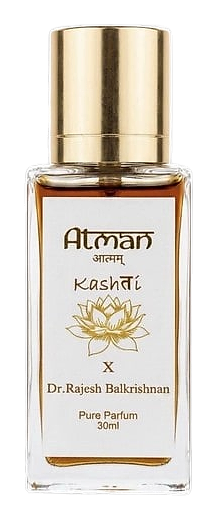
In Sanskrit, Ātman refers to the soul. Not the self that wants and thinks, but the witness beneath it, the presence behind the eyes. Still. Unchanging. That concept sits at the center of everything Kashti built this fragrance to say. Launched in 2026, Atman is a collaboration between perfumer Divyam Trivedi and Dr. Rajesh Balkrishnan, conceived as a soul-cleansing composition. Not a cleansing of surface, but something deeper, the kind of clarity that arrives when the noise finally stops. The fragrance weaves together rose, sandalwood, saffron, incense, and oud in concentric layers, each note circling the next like ripples in still water. The intent isn't adornment. It's anchoring. A scent that asks you to slow down and notice what's already there.
What makes Atman structurally interesting is how the composition refuses hierarchy. Turkish rose and Hasayan rose distillate (Chaiti Ruh Gulab) are layered rather than sequenced, each one visible to the other instead of taking turns. Indian oud forms a deep structural base, anchoring everything that rises above it with its resinous, animalic gravity.
The evolution
The opening doesn't so much announce itself as settle in. Kashmir saffron arrives dry and almost mineral, joined by the bright citrus cut of Spanish bitter orange and the warm shimmer of Madagascar pink pepper. Philippines elemi adds a clean, resinous clarity, while Omani Hojari frankincense rises behind it like smoke through a temple window. Present, then receding, then present again. The heart reveals itself gradually, a slow unfurling rather than a reveal. Turkish rose opens with its classic cool, jammy sweetness, but it's the Hasayan rose distillate underneath that gives the composition its particular depth, a honeyed warmth that softens the rose's sharper edges and lends the whole accord an almost candied richness. Kewra adds a delicate floral edge, orange blossom softens the composition's sharper corners, and Peru balsam introduces a quiet sweetness, resinous and grounding.
Cultural impact
Atman draws from a deep well of Indian olfactory tradition, where rose, oud, saffron, and temple incense have shared space in ritual and adornment for centuries. The composition reflects that lineage directly, naming Chaiti Ruh Gulab as one of its central materials and building the rest of the accord around it. This grounding in specific Indian raw materials rather than generalized orientalism marks a deliberate choice. The Sanskrit-derived name itself signals an intent to engage with fragrance as something beyond casual accessory, closer to contemplation.