The Story
Why it exists.
The beginning
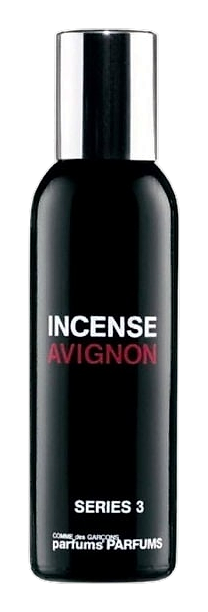
Avignon arrived in 2002 as part of Comme des Garçons' Series 3 Incense. The city's name points toward the medieval papacy, the Palais des Papes, the limestone weight of southern France. Bertrand Duchaufour composed it as a study in devotion. Not the comfortable kind. The kind that has burned for centuries in cold stone rooms where the air never quite clears. The fragrance division had been running for nearly a decade by then, a collaboration between Rei Kawakubo and Christian Astuguevieille. Each numbered series operates under the Comme des Garçons label, gathering related scents into a single thematic line that shares material and conceptual territory. Series 3 gathered incense compositions into one collection, with Avignon positioned among them.
Labdanum and elemi form the structural core, but Brazilian rosewood and Roman chamomile run underneath them, lending quieter tones that keep the composition from becoming monolithic. The rosewood adds a woody dryness, closer to pencil shavings than to polished furniture, and the chamomile contributes a hay-like herbaceousness that softens the edges just enough to let the resins breathe. Without those supporting notes, the incense would read as a single texture. With them, it gains depth.
The evolution
The first thirty minutes belong to the resins. Labdanum and elemi hit warm and slightly bitter, like heated bark before the smoke catches. Brazilian rosewood underneath adds a pencil-shaving dryness. Roman chamomile flickers at the edges, barely there, more suggestion than statement. This isn't a friendly opening. It's a room you're asked to enter. As the composition develops, the sharper top notes recede and patchouli begins to surface, bringing a damp earthiness that grounds the smoke. It feels less like burning incense now and more like standing inside an old stone building where incense has been burning for a long time. The character shifts toward something heavier and more weathered, with the patchouli lending a mineral, root-like quality that sits beneath the resin rather than competing with it.
Cultural impact
Avignon has earned a place among the incense fragrances that wearers return to repeatedly, the kind of scent that builds a quiet following through word of mouth rather than through major advertising. Its profile is distinctive enough to be recognizable on skin without being so loud that it crosses a room. The composition reads as serious, architectural, and deliberate, qualities that tend to attract wearers who already have a vocabulary for resinous and smoky materials. What Avignon does particularly well is sustain its character across a full day of wear without shifting into something unrecognizable.