
The Story
Why it exists.
The beginning
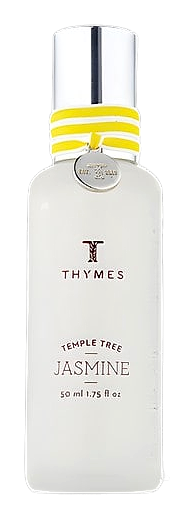
Thymes has always leaned toward botanical clarity, and Temple Tree Jasmine arrived in 2013 with a clear thematic anchor: the temple tree itself, Plumeria, the frangipani bloom whose petals are thick with nectar and whose scent has lived in temple offerings across South and Southeast Asia for centuries. The brand built the composition around that association, a jasmine-heavy white floral that reads as devotional and contemplative rather than declarative or showy. Thymes pulls tropical white florals into the formula, letting frangipani's waxy, sun-warmed presence shape the opening while jasmine sambac threads its greener character through the heart.
What's interesting here is the restraint of the composition. Temple Tree Jasmine sidesteps sharper edges by stacking frangipani with jasmine sambac, where frangipani brings a sun-warmed, sunscreen-adjacent creaminess that softens the sambac's greener profile. Ylang-ylang adds the banana-skin sweetness that makes the whole thing read tropical without straying into something overly sugary or synthetic. The Damask rose is the quiet move, a small amount of fruit-and-honey that keeps the white florals from going flat or one-dimensional.
The evolution
The opening is almost entirely frangipani, carrying that warm, waxy, slightly suntan-lotion quality that defines the fragrance's first impression. As the composition unfolds, the jasmine sambac arrives properly, green and faintly indolic at its edges, mixing with honeysuckle's honeyed nectar to create a full-bodied white floral heart that holds its shape through the early hours of wear. The coconut milk starts threading through once the heart has settled, and that's where the fragrance finds its true register: creamy, lactonic, still floral but now wrapped in something that reads more like skin than like a bouquet. In the later hours, most of the white florals have softened to a gentle hum, their individual characters merging into a unified presence. The coconut milk base persists longest, leaving a faint tropical cream on fabric the next morning.
Cultural impact
Temple Tree Jasmine occupies a specific register in the white floral category: the tropical, creamy, sunscreen-adjacent space that leans into lactonic warmth rather than indolic intensity. The coconut milk in the drydown shapes the fragrance's character, reading as a tropical cream that lingers into the late hours of wear. The composition's beach-adjacent creaminess makes it a natural fit for warm months and casual settings, where it reads as relaxed and unfussy rather than overthought or formal.