
The Story
Why it exists.
The beginning
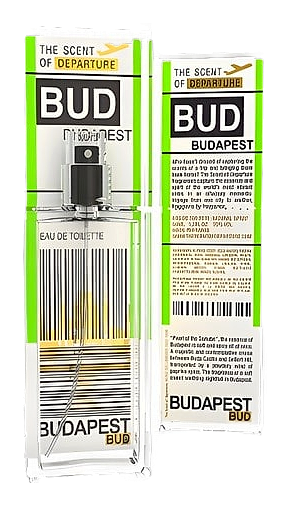
Every fragrance in The Scent of Departure's collection corresponds to a three-letter airport code, a format that captures the mood of transit rather than the postcard version of a city. Budapest BUD, released in 2011, takes its coordinates from Hungary's capital. The perfumer behind the scent is Gérald Ghislain, who composes with an emphasis on the finest raw materials. Rather than building a literal translation of Budapest's landmarks, Ghislain composed for the mood of the place: the blend of grandeur and quiet that settles over a traveler stepping off a plane into an unfamiliar terminal. The scent draws on Central European sensory cues without leaning on postcard imagery, instead trusting the materials themselves to carry the geography.
What makes Budapest BUD unusual is the confidence to lead with paprika, a note most other compositions treat as supporting player at best. Here it sits in the heart alongside clove, black pepper, saffron, and violet, backed by aquatic notes that keep the composition from tipping too heavy. That structure, warm spice tempered by something almost metallic and cool, gives the fragrance its particular character. The interplay between elemi resin in the opening and the woody base of cedar and white musk gives the fragrance an architectural backbone.
The evolution
This composition opens with the crackle of bergamot and elemi resin cut by sharp lemon peel. As the hours pass, the citrus yields to a denser resinous warmth, the fragrance settling into a quieter, more contemplative register. The transition from the sharp citrus top to the spiced heart happens within the first thirty minutes on most skin types, and the shift feels like a door closing behind you. Paprika and clove build slowly in the middle phase, joined by saffron's leathery glow and the cool hush of violet. The aquatic notes thread through everything, never loud but always present, the way a river's presence is felt before it is seen. By the third hour, the cedar has taken over the foreground, and the white musk underneath gives the whole composition a clean, almost architectural finish. The paprika never fully disappears, lingering at the edges like a word you can't quite place.
Cultural impact
Budapest BUD leans hard into Central European spiced-woody territory, a profile that stands apart from the citrus-driven compositions common in mainstream perfumery. Paprika-forward fragrances without gourmand sweetness carry a particular appeal for anyone drawn to dry spice and clean cedar rather than the sweetness that dominates most contemporary launches. The fragrance functions as a standalone composition for anyone drawn to its materials, regardless of geography, and the IATA code in its name simply signals the place that inspired it.