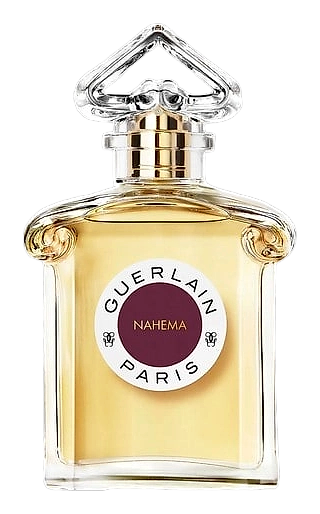

The Story
Why it exists.
The beginning
Jean-Paul Guerlain created Nahema in 1979 with a concept that was, for its time, quietly radical. The name derives from an Arabic and Persian root meaning paradise, a state of something desired but not quite possessed. That tension runs through the entire fragrance. Rather than building around a literal rose accord, Guerlain aimed to capture the emotional sensation of rose: its presence, its softness, its power to haunt. This was aromachemistry as illusion, perfume that smelled like a memory of something rather than the thing itself. The result became one of the most discussed compositions in the Guerlain canon, not for its ingredients but for what it managed to make you feel.
The pyramid reveals why Nahema continues to intrigue specialists. Aldehydes at the top give it an immediate vintage character, that sparkling, slightly soapy lift that marks the great classics. Peach arrives to sweeten the deal, Bulgarian rose follows to anchor the heart. But it's the combination in the base that creates the lasting impression: passion fruit adds unexpected tropical brightness, vetiver contributes a green-earthy depth, Peru balsam and sandalwood build warmth, and vanilla closes with cream. The composition works like a trick, it smells like a rose perfume, yet the structure doesn't depend on rose the way most rose perfumes do. That's not accident. That's the point.
The evolution
The aldehydes hit first, bright and silvery, announcing vintage glamour before you've had a chance to prepare. The green notes and peach arrive quickly, a crisp sweetness that lasts maybe twenty minutes before the florals take over. Then the Bulgarian rose dominates the heart, supported by hyacinth, lilac, ylang-ylang, jasmine, and lily of the valley, a dense floral matrix that smells rich, almost powdery, unmistakably of its era. The base is where Nahema becomes itself. Passion fruit, vetiver, Peru balsam, sandalwood, vanilla, a warm, slightly sweet foundation that doesn't behave the way you'd expect from the opening. On skin, expect eight to ten hours easily. On fabric, longer still. The vanilla and sandalwood drydown can linger for days.
Cultural impact
Nahema belongs to the Les Légendaires collection, Guerlain's curated selection of its most enduring fragrances. Within that canon, Nahema occupies a specific place: it's the one people debate. Specialists note that the composition appears to create the sensation of rose through aromatic chemistry rather than relying on actual rose materials, a technical tour de force that has made the fragrance a reference point in conversations about what perfume can do. The aldehydic character dates it, which is either a virtue or a limitation depending on who you're asking.
The House
GuerlainGuerlain stands as one of the oldest and most revered perfume houses in the world, founded in Paris in 1828 by Pierre-François-Pascal Guerlain. What began as a boutique on rue de Rivoli quickly became the preferred destination for Parisian society, attracting dandies and elegant women who sought custom-crafted fragrances. The house's influence grew to such heights that Guerlain earned the title of Official Perfumer to Napoleon III after presenting Eau de Cologne Impériale to Empress Eugénie as a wedding gift in 1853. This royal patronage marked the beginning of Guerlain's enduring association with European aristocracy, as the house went on to create fragrances for Queen Victoria and Queen Isabella II of Spain. Today, under the creative direction of Thierry Wasser, the fifth-generation perfumer, Guerlain continues to shape the landscape of fine fragrance with a portfolio spanning over 1,100 olfactory creations. The house remains headquartered at its legendary Champs-Élysées mansion, a historic monument that anchors Guerlain's position at the intersection of heritage and contemporary luxury.
The Creator
Jean-Paul GuerlainJean-Paul Guerlain's style resists easy categorization, though richness and depth define nearly every composition. He favored opulent oriental structures, warm woods and resins, and florals treated with almost sculptural precision.