
The Story
Why it exists.
The beginning
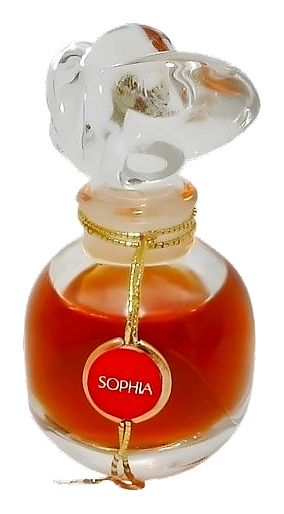
Sophia arrived in 1980 named for Sophia Loren herself, the Italian actress whose presence on-screen could stop a room. Coty had been building perfume legacies for decades at that point, but this was something new: a fragrance that wore its inspiration literally, trading the abstract for the iconic. The brief was clear. Capture Loren's particular gravity, the warmth, the fire, the way she held a frame without trying to fill it.
What makes the composition unusual is the push-pull between bright aldehydes and a base that leans animalic. The aldehydes give the opening a sharp, almost metallic brilliance that lifts the orange and bergamot into something theatrical. Beneath that, the heart is dense, jasmine and rose grounded by iris, and the base brings in Russian leather alongside ambergris, a pairing that moves the scent away from the powdery and toward the worn. Few houses in 1980 were building that kind of structural tension into a celebrity fragrance.
The evolution
The aldehydes hit first, that characteristic lift, bright and almost sparkling. Bergamot and orange follow within minutes, giving way to a warm floral heart where jasmine and rose overlap without competing. The spice builds quietly in the heart phase, cinnamon and clove threading through the florals like a suggestion rather than a declaration. By hour three, the ambergris and vanilla arrive, softening everything into skin-warmth. The Russian leather emerges last, sitting close and lasting through hour eight on most skin types, a quiet finish that stays with you the next morning.
Cultural impact
Sophia was the first celebrity fragrance, a category that would explode through the 1980s and beyond. Its launch in 1980 positioned it before the wave of celebrity scents that followed, making it something of an artifact: a celebrity fragrance that reads more like a perfume house composition than a licensing exercise.