The Story
Why it exists.
The beginning
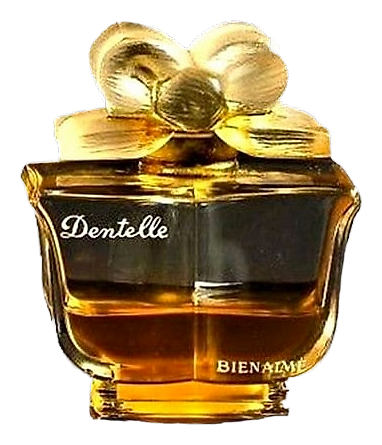
Dentelle, meaning lace in French, arrived in 1947 from Robert Bienaimé, a perfumer working in Paris. The name is a quiet thesis. Lace is structured but sheer, deliberate but delicate, the kind of fabric that reveals more by what it doesn't cover. Bienaimé built the composition to hold that same tension: bright aldehydes and citrus up top, a dense floral heart, and a base warm enough to suggest skin beneath the cloth. The opening hits you with a cold, soapy sparkle, the aldehydes lifting the bergamot and neroli into something almost metallic, like sunlight catching on a wire mesh. It feels less like a fragrance and more like a pattern held up to the light, geometric and precise. Then the florals start to gather.
What's distinctive here is the structure. The aldehydes aren't decorative; they create the actual framework the rest of the scent hangs on. Pair them with neroli and bergamot and you get a metallic, almost architectural brightness, the kind of cold shimmer that makes the florals behind it look warmer by contrast. Then the heart loads up with seven florals stacked tight, including clove for warmth and violet for that powdered hush. The way the clove cuts through the rose and jasmine gives the heart a faint spice, a suggestion of something edible without ever crossing into gourmand territory.
The evolution
The first 15 minutes feel almost industrial. Aldehydes hit with that classic Caron-like fizz, sharp and soapy, then neroli softens the edge into something more sunlit. Bergamot and orange keep it from going too cold. The citrus doesn't last long; maybe 30 minutes before the florals take over. Then comes the heart, and it's a bouquet with weight. Lily of the valley and violet lead, powdery and green, with rose and orange blossom curling around them. Clove adds a dry warmth underneath, and the tuberose-jasmine combo gives it body, a creamy density that the top never had. This is the longest phase, stretching through the 2-3 hour mark, and it's where the aldehyde structure still whispers through. The drydown is where things get interesting. Orris arrives first, that rooty, suede-like powder, and then the civet wakes up. It's not aggressive; it's a warmth, a suggestion of skin, the kind of intimacy old French perfumery was built on. Musk smooths everything out. Sandalwood and cedar add a dry, woody backbone. Oakmoss grounds it.
Cultural impact
For collectors of vintage French perfume, Dentelle is a reference point for what civet does in a white floral: adds warmth without heaviness, intimacy without sweetness. The kind of scent that rewards patience over projection. It belongs to a tradition of aldehydic florals that prized structural brightness and dense floral hearts, compositions where the aldehydes weren't an accent but the architecture itself. Dentelle is the sort of fragrance that changes depending on how close you are to it. From across a room, you might catch a faint trail of civet and musk, that animalic warmth doing its quiet work.
The House
BienaiméBienaimé is a Parisian fragrance house founded in 1935 by perfumer Robert Bienaimé, who brought his expertise from a distinguished career at Houbigant to create his eponymous brand. The house specialized in refined French perfumes that captured an elegant, understated vision of femininity and masculinity through carefully balanced compositions. After falling silent during the 1960s, Bienaimé returned to life in 2021 when Cécilia Mergui acquired the brand and began reissuing heritage formulas alongside new creations. The revival preserves the original spirit of the house while introducing the collection to a new generation of fragrance enthusiasts seeking authentic vintage character.
The Creator
Robert BienaiméBienaimé composed in the grand French tradition, favoring lush florals, elegant structure, and compositions that revealed their complexity slowly. He paired florals with warm woods, resins, and rare absolutes, building depth through layering rather than splash.