
The Story
Why it exists.
The beginning
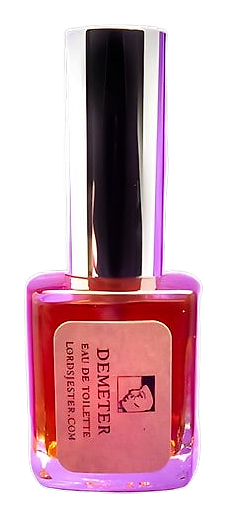
Lord's Jester launched Demeter during the 2000s, part of an early catalog named for Greek mythology. The label belongs to the goddess of fertility and agriculture, and the brand frames the scent accordingly. Think hay fields, childhood summers, the smell of grass drying under a hot sky. Adam Gottschalk, the house's perfumer, built Demeter around that pastoral idea, threading thirteen naturals into a composition that leans woody, herbal, and quietly resinous rather than sweet. The mythological naming convention defines Lord's Jester's identity through its releases, with Demeter sitting among earlier house offerings that helped shape the catalog's thematic bones. The fragrance reads as an olfactory sketch of the countryside, built on a backbone of grass, leaf, and warm wood resin.
Thirteen notes is a lot for a fragrance that reads so simply on skin. The trick is layering aromatics that share a register: fir cone and stone pine needle up top, sandalwood and ambrette down low, all sitting in the same dry-woody neighborhood. Pink pepper adds a spark without sweetness. Benzoin and ambergris give the base a faint sweetness, but the hay and tobacco anchor everything back to grass and leaf. The shared register between top and base is what keeps the composition unified, as if every note grew in the same field and was gathered within hours of each other.
The evolution
Demeter opens with a brisk, almost bitter green, fir cone and neroli hitting first like walking under pines after rain. Pink pepper sits underneath, a faint warmth, barely there. The first 30 minutes are the coldest the fragrance gets. Around the 45-minute mark, jasmine and orange blossom surface, not as a bouquet but as a texture, something floral and creamy blending with rose into a sun-through-clouds warmth. The heart doesn't shout. It just softens everything. By hour two, the base takes over. Hay is unmistakable, that dry grassy sweetness, sitting alongside tobacco leaf and benzoin. Sandalwood and ambrette warm the whole thing from below, giving it skin-like closeness. The stone pine needle holds on longest, a resinous thread you can still catch at hour five or six, pressed into whatever fabric you were wearing.
Cultural impact
Demeter sits in the early tier of Lord's Jester's catalog, alongside Selene, Helios, and Aphelia, releases that helped shape the house's mythological direction. It shares a closely related profile with Chronos, another house release, reflecting a consistent woody-green-pastoral house style. Among perfumery enthusiasts, the fragrance earns respect for its unusual hay-tobacco drydown, a combination that gives the composition a distinctive agricultural character.