The Story
Why it exists.
The beginning
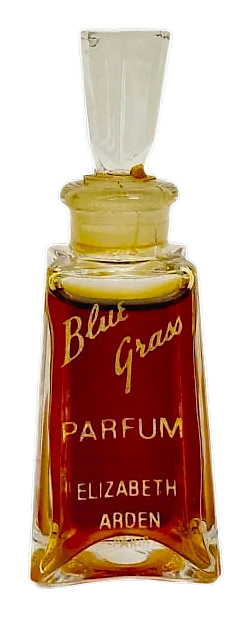
Blue Grass arrived in 1934 from Elizabeth Arden, a company still building its American beauty empire one salon at a time. George Fuchs composed it, working in the floral-spicy idiom that defined an era when perfumery leaned heavily on green florals, aldehydes, and warm musky bases. The composition itself is what made Blue Grass notable: a green aldehyde opening layered over a spicy floral heart, finishing with Tonkin musk and tonka in the drydown. It was formulated as something wearable, something a woman could reach for every morning without ceremony, and that accessibility has remained central to its identity across the decades. The fragrance helped establish Arden's presence in perfumery during a period when American houses were beginning to stake their own claim in the category.
What sets Blue Grass apart is its structure, a green aldehyde opening that doesn't announce itself as vintage, a spicy floral heart built on clove and narcissus rather than the more common rose-jasmine duo, and a base that warms into Tonkin musk and tonka bean. The narcissus in particular gives it a slightly earthy, almost hay-like undertone that gives the whole composition a grounded, naturalistic feel. The aldehydes provide lift that keeps everything from collapsing into sentiment, which is dangerous territory any decades-old floral risks when the formula hasn't been chased into trendiness.
The evolution
The first 20 minutes feel almost architectural. Aldehydes, bergamot, and neroli land with a fizzy clarity, the lavender softening the edges so nothing reads soapy. Orange adds a sweetness that pulls you in before you notice you're paying attention. By the 45-minute mark, the florals take the floor. Rose opens, but it's not the lead. Clove and narcissus take turns running the show, with jasmine and tuberose filling in the corners. The heart has a green snap to it, likely the narcissus doing its hay-and-earth work, that keeps the florals from going soft. Around the 4-hour mark, the base takes over. Benzoin and tonka bring a low sweetness, more caramelized than sugary, while Tonkin musk and sandalwood ground everything in a creamy, slightly animal warmth. The musk in particular deepens the composition, giving it that second-skin quality that separates a fragrance from a mere scent.
Cultural impact
Blue Grass has earned a particular kind of devotion among wearers who value clean, classic florals over trend-driven compositions. It's the kind of fragrance people buy once and then buy again, year after year, because the bottle on the shelf represents something reliable in a category that constantly reinvents itself. The narcissus-heavy heart and the warm musk base give it a distinctive signature that stands apart from the lighter, more transparent florals that dominate modern releases.