The Story
Why it exists.
The beginning
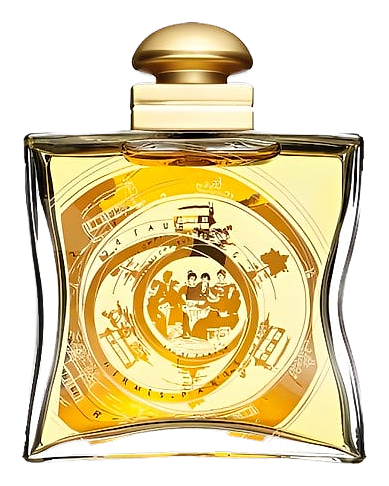
In 1937, Hermès released its first-ever silk scarf, designed by Hugo Grygkar. The pattern depicted a board game called 'Jeu des Omnibus et Dames Blanches', carriages and white-dressed players, a snapshot of Parisian social life. The scarf became a house icon. Decades later, in 2011, Hermès turned it into something you could wear. The perfume is a limited-edition collector's bottle of 24, Faubourg Eau de Parfum, with a case decorated after Grygkar's original design. Serge Mansau handled the bottle architecture. Maurice Roucel and Bernard Bourjois composed the fragrance itself, translating the scarf's visual elegance into olfactory terms, its richness, its narrative quality, the sense of a place and a time captured in a repeating pattern.
The note structure here is unusual. Five top notes including hyacinth, which is rare at this volume, it brings a green, almost aquatic sharpness that cuts through the sweetness. The heart piles on gardenia, jasmine, and black elder, all creamy and intense. Then iris arrives in the middle, adding that powdery sophistication Hermès handles so well. The base settles into amber, sandalwood, patchouli, and vanilla, warm without heaviness. It's a white floral built to last, not to apologize for itself.
The evolution
It opens bright and almost green, the hyacinth dominant. Bergamot flickers underneath, keeping it cool. Within twenty minutes the orange blossom and gardenia take over, this is where it becomes unmistakably white floral. The peach note adds sweetness without fruitiness, more like the idea of warmth than actual fruit. The heart holds for two to three hours, rich and slightly indolic in the way gardenia always is. Then it shifts. The iris emerges, powdery and elegant, meeting the sandalwood. The drydown is where Hermès earns its reputation, amber and vanilla close to the skin, patchouli giving it just enough earth to stay interesting. On fabric, it lingers overnight. On skin, expect five to six hours of something that feels both lush and restrained.
Cultural impact
A limited-edition collector's bottle based on an existing fragrance, 24 Faubourg Eau de Parfum, makes this a piece for those who already know the house and want something rarer. The 2011 launch places it in an era when Hermès was expanding its fragrance identity beyond the minimalist work of Jean-Claude Ellena, moving toward richer, more narrative-driven compositions. It attracts the wearer who wants Hermès but desires something with more presence than the typical Hermessence offering.