
The Story
Why it exists.
The beginning
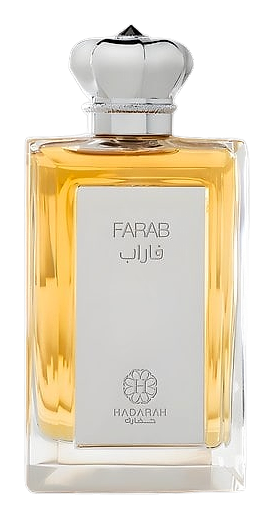
Farab entered Hadarah's catalogue in 2015 with a name tied to Al Farabi, the scholar and philosopher associated with Baghdad's scientific and artistic legacy. That intellectual reference gives the scent a thoughtful register, though its character is never academic. Instead, it arrives through fruit and citrus, then moves toward incense, spice, and woody depth. The composition is unisex by design, pairing a bright opening with materials that feel closer to an evening setting, a carved interior, or a column of warm smoke rising in low light.
The interesting part is the contrast. Apple, blackcurrant, pineapple, and bergamot give Farab a vivid, almost sparkling beginning, while jasmine, pink pepper, patchouli, and frankincense pull it into aromatic shadow. Frankincense appears in both the heart and base, giving the drydown a resinous continuity. Amber and vanilla soften that structure without erasing it, while musk and oakmoss settle the composition into a dry, woody finish.
The evolution
Farab begins on its most playful surface. Apple and pineapple give the opening juicy sweetness, while bergamot cuts through with clean citrus tension and blackcurrant adds a dark berry edge. That brightness soon gives way to jasmine and pink pepper, where floral softness meets a controlled flare of spice. Patchouli and frankincense then pull the scent downward into resin, earth, and wood. The base arrives gradually: amber warms the composition, vanilla rounds its edges, and musk carries a clean skin-like warmth while oakmoss keeps the finish woody and grounded. Through the expected 4-6 hour wear, the fruit fades first, leaving incense and patchouli in charge. What lingers is the contrast, sweet but never syrupy, smoky but still polished. By the final hours, Farab sits close to the skin like polished wood, faint vanilla, and a trace of resin.
Cultural impact
Farab fits Hadarah's broader practice of using names connected to the Muslim world to frame a contemporary aromatic atmosphere. Its intellectual reference sits alongside the house's more direct expressions of regional scent culture, making it less a literal historical reconstruction than a modern composition with a scholarly name. The name also helps position it for wearers drawn to Hadarah's blend of cultured references, architectural presentation, and contemporary projection.