The Story
Why it exists.
The beginning
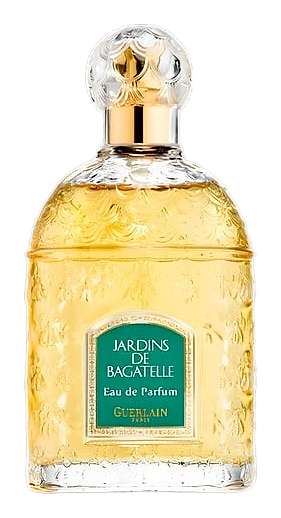
The Bagatelle gardens have always been about abundance without apology, a palace of romantic follies, ringed by flowers that refuse to behave. When Jean-Paul Guerlain composed Jardins de Bagatelle, he reached for that same energy. This was a fragrance meant to capture a garden at its most lavish, not a single stem but the whole bed in riot. White florals, aldehydes, and citrus arranged as a statement rather than a suggestion. It found its place among the Les Légendaires as a fragrance that announces itself with unmistakable confidence.
What makes this composition unusual is the density of the floral heart. Most fragrances choose one or two white florals as a focal point. Jardins de Bagatelle stacks them, jasmine, gardenia, tuberose, ylang-ylang, rose, magnolia, narcissus, orchid, lily of the valley, nine florals in the heart alone. The aldehydes that open the fragrance don't fade quickly; they carry through the heart, giving the florals a luminous, almost powdery glow rather than a creamy texture. The result is a garden that reads as both fresh and opulent, a balance few fragrances attempt at this scale.
The evolution
The opening is immediate and bright. Aldehydes give bergamot and lemon a sparkling quality, cool and fizzy, with the violet lending a powdery softness underneath. As this phase develops, the florals gradually take over. The heart is where Jardins de Bagatelle earns its name. Jasmine and gardenia arrive first, joined quickly by tuberose, ylang-ylang, and the supporting cast of rose, magnolia, and lily of the valley. The aldehydes don't disappear; they persist through the heart, keeping the florals luminous rather than heavy. This is the phase that defines the fragrance for most of its wear. As the hours pass, the florals begin to thin and the vetiver asserts itself, bringing an earthy, slightly bitter green counterpoint that cuts through the sweetness. Cedar and patchouli arrive late, grounding everything in a warm, woody drydown that lingers close to the skin.
Cultural impact
Jardins de Bagatelle stands as a defining work within Guerlain's Les Légendaires collection, representing Jean-Paul Guerlain's vision of translating the grandeur of French formal gardens into liquid form. The fragrance became part of a curated collection celebrating the house's most significant creations. Its aldehydic white floral structure showcases classical perfumery techniques that have defined the house for generations, creating a composition that balances opulence with restraint.