
The Story
Why it exists.
The beginning
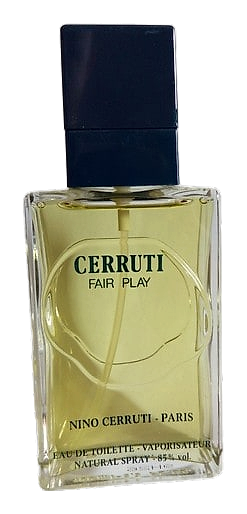
Fair Play arrived in 1985 as part of Cerruti's expanding fragrance collection, translating the house's tailoring philosophy into a different medium entirely. Where the fashion house built its reputation on architectural precision and continental restraint, the perfume needed to communicate the same values through material rather than cut. The brief seems to have been simple: confident without announcement, structured without rigidity. The aromatic spicy citrus category was well-established by the mid-80s, but Fair Play staked out different territory, one foot in the crisp green herbs that defined the era's masculine vocabulary, the other in a warmth that would outlast the trend cycle. What emerged was a composition that prioritized balance over boldness, and longevity over spectacle. It didn't try to start conversations. It assumed you'd already been introduced.
What makes Fair Play's structure unusual for 1985 is the relationship between its opening and its drydown. The cool, aromatic lavender and basil create an immediate impression of restraint, clean, herbaceous, almost austere. But beneath that opening sits something unexpected: carnation and geranium, florals that add a subtle warmth to the heart that seems borrowed from a different category entirely. Then there's the vanilla. In a decade dominated by fougère structures and sharp citrus openings, the presence of vanilla in the base is notable, it's present, confident, and unapologetic. Not sweet for the sake of sweetness, but warm because warmth was the point. The cedar and leather give it structure.
The evolution
The opening hits crisp and immediate, citrus oil brightness (bergamot, lemon, mandarin) meeting the cool green of basil and the lavender that anchored so many men's fragrances of the era. No hesitation here. The herbaceous clarity announces itself and holds for the first twenty minutes, perhaps thirty on cooler skin. Then the florals begin their quiet takeover. Carnation and geranium don't arrive all at once, they seep in gradually as the citrus recedes, adding a subtle warmth that feels earned rather than announced. The transition from green herbs to floral warmth is Fair Play's most interesting move. By the time the base notes arrive, the composition has shifted registers entirely. Cedarwood takes the lead, but the vanilla appears before long, not as a dominant force, but as a warm undercurrent that persists through leather, moss, and amber. The drydown is powdery, slightly sweet, and lingers close to the skin for the remaining hours. Moderate sillage means this isn't a fragrance that fills a room, but one that rewards proximity.
Cultural impact
Fair Play occupies an interesting position in masculine fragrance history: it's frequently cited as a precursor to YSL Jazz, released later in the decade. Those familiar with Jazz's DNA can trace that aromatic-spicy-woody-leathery structure back to Fair Play's 1985 template. The comparison isn't incidental, reviewers consistently note the structural similarity, suggesting Fair Play may have planted a seed that YSL cultivated more broadly. For collectors and enthusiasts of vintage masculine fragrances, Fair Play represents a particular moment in the category's evolution, aromatic spicy with a floral heart, woody base, and a vanilla presence that felt forward-thinking for its time.