The Story
Why it exists.
The beginning
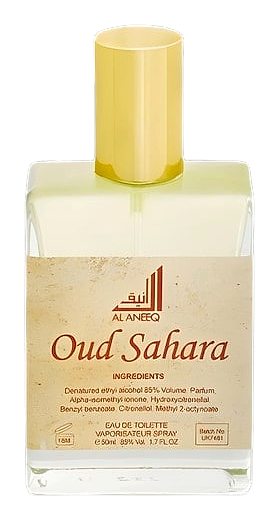
The name does what it says, and the composition earns it. Agarwood sits at the center, surrounded by the materials an old stone room might hold: beeswax, papyrus, frankincense, the sweetness of something offered and then left to cool. There is resin, smoke, and the memory of somewhere built by hand, all working together to build the deeper hours when heat breaks and the air turns quiet. Released as a perfume oil, it goes straight to skin, which changes how each note behaves over time. Without the alcohol architecture of a spray, the materials take their time unfolding, settling into a slower rhythm against the warmth of the body. The oud doesn't blast out of the bottle. It waits. It hums.
What separates Oud Sahara from a standard Arabian oud blend is the texture work. Beeswax and papyrus arrive in the heart alongside jasmine and rose, and that pairing does something unusual. The wax gives the florals a tallow-lit quality, almost devotional. The papyrus adds a dry, fibrous grain that prevents the florals from going syrupy. Then frankincense, labdanum, benzoin, and Peru balsam stack up in the base for a resinous density that reads warm but not food-sweet. The vanilla is restrained enough to read as incense ash rather than dessert.
The evolution
The first ten minutes belong to the cypress. Green, dry, almost pencil-shaving sharp, with bitter orange threading through it like a cold citrus rind catching light. This isn't a smooth entry. It has edges. Then the oud breaks through, and it doesn't ease in. It arrives heavy and resinous, wrapped in beeswax that reads almost liturgical, like the air inside an old stone chapel. The papyrus gives the mid-phase a fibrous dryness that keeps the jasmine and rose from going soft. They're there, but they sit behind the wax and wood like icons half-shadowed on a wall. Over the next few hours, the frankincense climbs. Labdanum and benzoin thicken the base into something that feels warm against the skin but doesn't announce itself across the room.
Cultural impact
Oud Sahara reads as atmosphere more than as a personal scent, closer to a room than a statement. It sits comfortably in the category of resinous, layered compositions that prioritize depth over projection, wearing in rather than projecting out. The devotional quality that wearers pick up on comes through in the incense-ash vanilla, the beeswax-lit florals, the way the whole composition settles into something that feels ritualistic without ever tipping into costume. It's the kind of fragrance that changes the air around the wearer as much as it scents the skin.