The Story
Why it exists.
The beginning
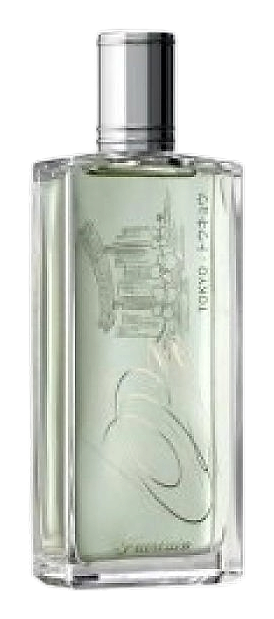
Part of Guerlain's Les Voyages Olfactifs collection launched in 2009, Paris-Tokyo imagines a crossing between two cities that have always shared a sense of restraint. The series translates places into scent, and this particular stop draws a line from Parisian clarity to Japanese stillness. The green tea top is the Japanese hand reaching across, while the violet and jasmine carry the French floral lineage Guerlain has refined for generations. Hinoki wood, a sacred Japanese cypress often used in temple architecture and bathhouses, anchors the base with something unmistakably architectural. The bottle was designed by Serge Mansau, continuing Guerlain's tradition of treating the flacon as an object worthy of the juice inside.
What makes this composition interesting is the way it holds two registers at once. Green tea is meditative, almost monastic, a note that asks for silence. Hinoki wood is structural, the scent of cypress, papery and dry, calling to mind a beam or a bathhouse bench worn smooth by years of steam. Pairing them with violet and jasmine creates a dialogue between the perfumed and the plain-spoken. The violet arrives cool, dusting the green with something soft and slightly powdery, while jasmine threads underneath, white-petaled and unhurried.
The evolution
The opening is all green tea, sharp and almost leafy, like crushed matcha before the whisk comes out. Violet arrives soon after, dusting the green with something soft and slightly cold, the way floral powder sits on cold skin. In time, jasmine has threaded through, white and quiet, pulling the composition toward its floral center without ever fully committing to sweetness. The drydown is where hinoki wood takes over. It smells drier than most woods, more papery, with a faint sweetness underneath that never tips into the dessert register. Longevity is respected by enthusiasts who appreciate a quieter construction, and the scent stays close to the skin after the first stretch of wear, which is to its credit. On fabric the next morning, you'll catch a faint trace of wood, the ghost of something that was never loud to begin with.
Cultural impact
Paris-Tokyo arrived in 2009 as part of Guerlain's Les Voyages Olfactifs series, a collection built around the idea of olfactory travel. It sits in a quieter register than most Guerlain offerings, a composition that prefers suggestion over declaration. Wearers tend to gravitate toward it for warm-weather days and transitional seasons, and it finds its audience among people who want something floral without surrendering structure. The fragrance reads as a postcard between two cities, one that arrives without urgency and stays in the room longer than you might expect.