
The Story
Why it exists.
The beginning
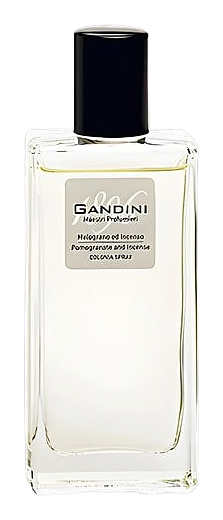
Pomegranate and Incense arrived in 2010 as part of Gandini's Maestri Profumieri collection, a group of fragrances designed to be layered, combined, worn together or alone. The brief was simple: take ingredients that carry weight in Italian olfactory tradition and push them into conversation with each other. Pomegranate had been used in perfumery before, but rarely as a leading voice. It needed a counterpoint that could match its tartness without flattening it. Incense was the answer, not the church-incense of Western tradition, but the warm, slightly balsamic resin smoke that connects Italian perfume history to the spice routes beyond the Mediterranean. The composition was built around that tension: bright fruit against dark resin, the acidic against the sacred.
What makes this structure unusual is the sequencing. Most fruity-smoky fragrances start with the fruit and let smoke arrive as a modifier. Here, the pomegranate doesn't fade, it evolves. The raspberry and orange in the top accord keep the opening from reading as purely tart, adding a juiciness that persists well into the heart. Meanwhile, the incense doesn't wait. It begins its work within the first few minutes, not overpowering the fruit but threading through it, so that by the time the heart notes fully develop, the wearer experiences something closer to a fusion than a transition. The black pepper and cloves add warmth without spice-forward sharpness.
The evolution
The opening is pomegranate's show. Sharp, almost astringent, with the orange lifting the tartness just enough to keep it from reading as medicinal. The raspberry arrives within minutes, rounding the edges into something juicier. On some skin, this phase lasts fifteen minutes. On others, closer to thirty. Then the incense begins to move. Not smoke, warmth. The distinction matters. Smoke reads as an effect; incense warmth reads as a quality of light. The cloves and black pepper amplify this, adding a resinous heat that the florals can't quite soften away. By the second hour, the base notes have arrived. Cedarwood dominates, but it's the guaiac wood that adds the unexpected depth, slightly smoky, slightly sweet, different from cedar in a way that rewards attention. Patchouli anchors everything. Musk keeps it close to the skin rather than projecting outward. The drydown on this one is intimate. It doesn't fill a room. It rewards proximity.
Cultural impact
Pomegranate and Incense arrived in 2010 during a period of renewed interest in Italian artisanal perfumery. The fragrance captured a moment when niche houses were exploring unconventional note combinations, specifically the contrast between bright, tart fruit notes and the depth of smoky resins. The pomegranate note was relatively uncommon in Western perfumery at the time, more frequently found in Middle Eastern compositions. Gandini's 2010 release positioned this fruity-smoky structure within an Italian chypre framework, a deliberate choice that connected the experimental note pairing to a traditional Western perfumery classification.