The Story
Why it exists.
The beginning
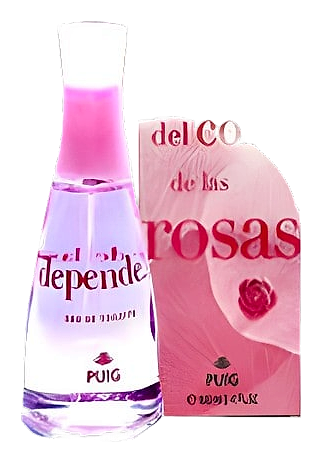
Depende del Color de las Rosas landed in 2001 from Antonio Puig, a Spanish house. The title translates loosely as "It depends on the color of the roses," a phrase that gestures at the same flower's capacity for wildly different moods. Some roses are loud. Some are barely there. This one sits firmly in the second camp, favoring a whisper over a declaration. The composition is built on a narrow architecture: petitgrain, rose, musk. Three materials doing the work of thirty, each one carrying more weight than the modest note list suggests. Petitgrain brings that bitter green snap, the woody-leaf character that prickles at the edges before softening. Rose appears in its quieter register, less a bouquet than a single stem held at arm's length.
What makes the structure interesting is the restraint. This one builds inward rather than outward, stripping away the usual supporting cast and letting three materials carry the entire conversation. Petitgrain, the leaf-oil cousin of neroli, opens with a bitter green snap that frames the rose rather than smother it. The green doesn't shout. It sketches a border around the floral, keeping things contained. Then the musk arrives and doesn't leave. The musk functions as more than a drydown here.
The evolution
The opening minutes lean heavily on petitgrain, that green-twig bitterness some people compare to crushed leaves or fresh wood shavings. The bitterness is real, a little sharp, the kind of green that makes you pay attention before the softer elements arrive. The rose shows up quietly underneath, not announced, just present. It doesn't push forward immediately. It waits, letting the petitgrain have its moment. As the fragrance settles, the two notes blend into something more unified, the green softening while the rose gains confidence. The rose never becomes dominant, but it stops hiding. Musk arrives somewhere in the middle stretch and never really leaves. It threads through every phase, giving the composition a continuous warmth underneath the shifting surface.
Cultural impact
The rose-p petitgrain-musk triangle puts it closer to a clean skin scent than to a statement floral. That positioning matters. Many rose fragrances aim for opulence, layering supporting florals, heavy bases, generous sillage. This one resists that instinct almost completely. The result is a composition that feels closer to skin than to perfume, more like a personal trace than a public announcement. It's the kind of fragrance that works in warm weather, in close quarters, for someone who wants to smell like themselves with a gentle floral accent rather than like a walking bouquet. The minimal note list reinforces that sense of intention.