
The Story
Why it exists.
The beginning
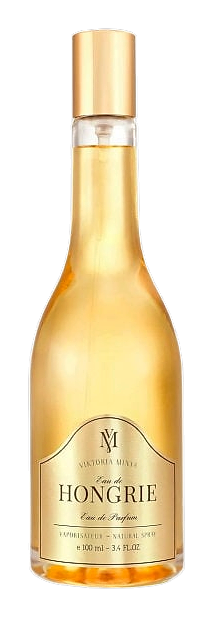
Some stories refuse to stay buried. The legend of Eau de la Reine de Hongrie lingered in Viktoria Minya's imagination long after she first encountered it, a whisper of an old Hungarian queen named Elizabeth and a recipe that predates nearly every perfume formula we now take for granted. Trained as a perfumer and drawn to the intersection of history and scent, she returned to that legend as a creative anchor, a way to root her work in something older than trends. In 2014, she made it tangible: Eau de Hongrie, her modern interpretation of the queen's recipe, anchored in Tokaji wine, the golden dessert wine of Hungary.
What gives this composition its gravity is the Tokaji wine note. Sweet dessert wines don't often show up in fragrance, and when they do, they usually arrive as generic syrup. Here, the wine acts as a structural element, its fermented brightness cutting through the honey so the opening never collapses into pure confection. The immortelle in the heart does the same work from the other direction, pulling the composition toward something resinous and dried-fruit-adjacent, so the gourmand weight never goes slack.
The evolution
Eau de Hongrie draws on the legend of Eau de la Reine de Hongrie, a formula often described as the first modern eau de cologne. Viktoria Minya reinterpreted that historical recipe through her own lens, anchoring the composition in Tokaji wine, a Hungarian dessert wine, alongside honey and immortelle. The result reads as a warm, gourmand take on a medieval queen's tonic, released in 2014 and rooted in her Hedonist-era work. What sets it apart from the rest of the line is its willingness to lean fully into sweetness without apology, trusting the wine's natural acidity and the immortelle's resinous pull to keep the composition upright. The opening is bright and almost candied, grapefruit and clove catching the light before the honey settles in. Within minutes, the Tokaji arrives, lending a fermented, almost cidery edge that complicates the sugar.
Cultural impact
Eau de Hongrie sits in an unusual corner of fragrance: it's gourmand enough to appeal to fans of honey-and-tonka compositions, but the Tokaji wine note and the immortelle's intensity give it a character that doesn't map neatly onto any mainstream category. Wearers tend to describe it as a winter-evening scent, the kind of thing that earns its warmth rather than performing it. The wine note carries a fermented, almost cidery brightness that lifts the honey and prevents the composition from sliding into pure sweetness, while the immortelle introduces a resinous, maple-like undertow that grounds the whole thing.