The Story
Why it exists.
The beginning
Viktor & Rolf launched Flowerbomb in 2005, a fragrance built around a provocation rather than a garden. The name set the brief. Not a meadow, not a quiet cluster of petals. A bomb. The duo behind the house wanted a floral that didn't demure, that announced itself before the wearer spoke. They brought in Olivier Polge, then building his early career at IFF, alongside a team of perfumers that included Carlos Benaim, Domitille Michalon-Bertier, and Dominique Ropion. The collaboration produced something closer to a statement than a scent: sweetness pushed to excess, florals stacked past the usual restraint, the idea that a single fragrance could carry an entire visual argument in its wake. From the first spray, Flowerbomb reads as an act of emphasis rather than subtlety.
What makes Flowerbomb structurally interesting is the way it balances its own ambition. The top notes, tea and bergamot with osmanthus, are the calm before the detonation. The heart stacks orchid, jasmine, rose, freesia, and African orange flower into a layered density that holds together because each bloom pulls in a slightly different direction. Orchid brings the cream. Jasmine brings the indolic warmth. Rose brings the jammy, almost wine-like depth. Freesia cuts through with a cool, green-pepper brightness.
The evolution
The opening arrives cool and almost translucent. Tea and bergamot give it a clean, slightly bitter edge, the osmanthus adding a leathery apricot nuance that reads as more sophisticated than sweet. Within ten minutes, the whites take over. Jasmine and rose push forward first, then the orchid unfolds a creamy, almost custard-like warmth that fills the chest. The freesia keeps it from going heavy, adding a green peppery lift that stops the florals from collapsing into sweetness. As the second hour approaches, the patchouli surfaces, not the raw earthy kind but a polished, slightly chocolate-toned version that wraps the florals in something denser. The musk and vanilla arrive last, and they stay. Powdery, slightly creamy, with that warm-skin softness that makes the hours after the florals fade the most intimate part of the wear. On fabric, the next morning still carries it.
Cultural impact
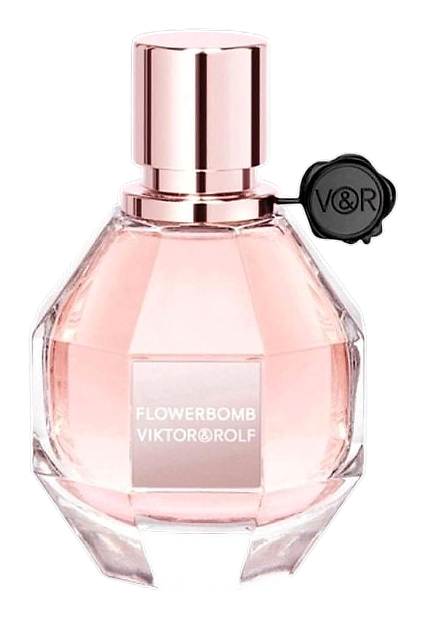
Flowerbomb arrived in 2005 and quickly became a presence on counters around the world. Its faceted, diamond-grenade bottle, designed by Fabien Baron, is part of why the fragrance registers as an object before it ever reaches skin. The scent itself is dense, sweet, and unmistakably floral, the kind of composition that fills a room rather than whispers from a wrist. It established a particular kind of olfactory statement: warmth, powder, and white-floral sweetness built up to a level that feels deliberate rather than accidental.