The Story
Why it exists.
The beginning
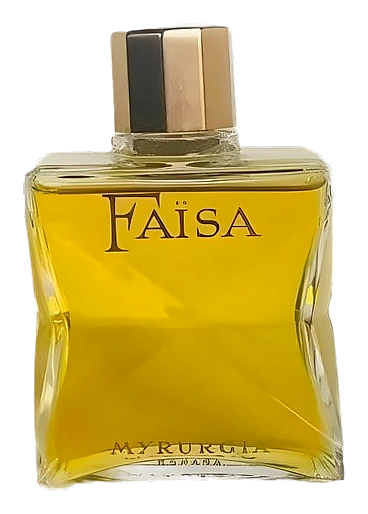
Faisa arrived in 1935 as part of the Myrurgia catalogue, released during a formative period for the house. The fragrance entered as a floral aldehyde for women, a type of composition rooted in early twentieth century traditions. By the mid-1930s, Myrurgia was producing pieces that reflected the restrained, structured aesthetic common to that era of perfumery. Faisa carried that sensibility with a powdery center, a softness that felt deliberate rather than accidental. The composition held back where others might have indulged, giving the florals room to breathe without sliding into excess. The fragrance was later reformulated and briefly relaunched in 1977, though production has since ceased again, making surviving bottles a window into a specific moment in Myrurgia's output.
What makes Faisa worth a second look is how it handles its aldehydes without losing warmth. The opening carries that characteristic aldehyde lift, bright and a touch sharp, but the composition refuses to stay cold for long. Almost immediately, a powdery softness moves into the center, grounding the brightness before it can feel austere. Carnation and rose form the floral heart, each pulling against the other. Bergamot opens the door with a short citrus gesture before the florals take over.
The evolution
The first ten minutes belong almost entirely to the aldehydes and bergamot, a bright, slightly metallic spark that sits close to the skin without pushing outward. There's a soapy quality here, but it reads more like fresh linen than bathroom soap. Around the 15-minute mark, the heart unfolds: carnation and rose arrive first, slightly sweet but cut short by a dry cedarwood backbone that keeps the florals from spilling into confection. Jasmine threads through without dominating, adding a greenish warmth. By the one-hour mark, the aldehydes have mostly burned off, leaving a powdery softness anchored by amber and a quiet musk that clings to fabric. The composition stays close to the body throughout, a quiet arc rather than a loud one. It never projects aggressively but it also never fully disappears, maintaining presence without demanding attention.
Cultural impact
Faisa sits in an unusual position as a discontinued floral aldehyde with a reformulation history that includes a 1977 relaunch. Its discontinued status makes surviving bottles objects of interest for anyone drawn to aldehyde-driven compositions. The reformulation and 1977 reintroduction briefly brought the fragrance back into circulation before production ceased again. Reviews of the fragrance describe its character as notably soft and approachable, with a powdery center and a clean drydown that feels warm without becoming heavy. The aldehydes, rather than dominating, serve as a bright opening that recedes into florals and base notes.