
The Story
Why it exists.
The beginning
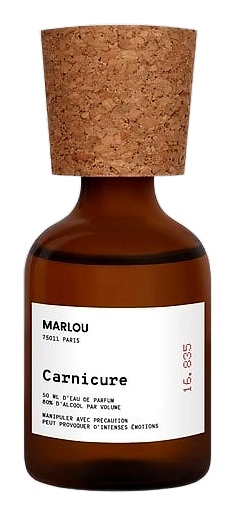
Carnicure is where Marlou's philosophy becomes scent. Rather than constructing another fantasy of refinement, the house built a fragrance around the tension between pretty and true. Violet and orange blossom arrive like a soft opening, the kind that says hello before saying anything real. But behind that floral courtesy lives something the perfumer wanted you to find: animalic warmth, resinous depth, the smell of skin that knows itself. The composition unfolds as a conversation between surfaces, the composed and the honest, the powdered and the living. There's an interplay between delicate floral top notes and a deeper, warmer heart that reveals itself gradually, creating a sense of intimacy rather than spectacle.
The combination of violet with civet is unusual precisely because it shouldn't work. Powdery florals tend to recede from animalic notes, creating separation rather than dialogue. Here, the violet doesn't retreat, it contextualizes. The civet gains elegance from the floral frame, while the powder keeps the animal from becoming heavy or medicinal. Labdanum serves as the translator, its resinous amber quality bridging the two territories into something that reads as warm skin rather than either extreme. This is what makes Carnicure distinctive: it doesn't choose between pretty and animalic. It holds both, the way living things do.
The evolution
The opening arrives in seconds. Violet and orange blossom bloom bright, immediate, almost decorative. Then, within minutes, the mask slips. Powdered fur emerges, the kind that suggests warmth underneath. The floral doesn't disappear. It becomes the setting for something more honest. By the second hour, patchouli and sandalwood anchor the composition in earthy depth while musk and civet do the work that no one talks about at perfume counters. Labdanum adds a dusty resinous quality that keeps the whole thing from becoming sweet. The drydown holds close. Intimate. The kind of scent you catch when someone leans in, not when they enter the room. The fragrance lingers at skin level, revealing itself slowly to those who come close enough to notice.
Cultural impact
Carnicure became a reliable recommendation for wearers seeking animalic depth. The fragrance occupies a specific space: honest enough to reward attention. For those who appreciate what lies beneath the surface of a scent, it offers something worth noticing up close. The composition appeals to anyone who wants fragrance that reveals itself gradually rather than announcing itself.
The House
MarlouMarlou is a Paris-based niche fragrance house founded in 2016 by a creator operating under the pseudonym Odeurs Du Corps. The house emerged with a single guiding conviction: that perfumery should address the body in its full, unfiltered reality, including its shadows and imperfections. Rather than masking or perfuming over the human form, Marlou constructs scents that acknowledge and intertwine with corporeal existence. The house maintains a deliberately restrained catalog, releasing fragrances at its own pace rather than following seasonal industry cycles. Each composition explores different dimensions of bodily experience, from the intensely animalic to the quietly meditative. Marlou has garnered a devoted following among collectors who prize its uncompromising vision and its refusal to soften the human condition into something more palatable.
The Creator
Tristan RostainRostain favors materials with architectural presence—woods, resins, and mineral aromatics that provide volume and definition rather than softness. His compositions tend toward clarity: sharp transitions, defined negative space, accords that hold their shape over time rather th…