
The Story
Why it exists.
The beginning
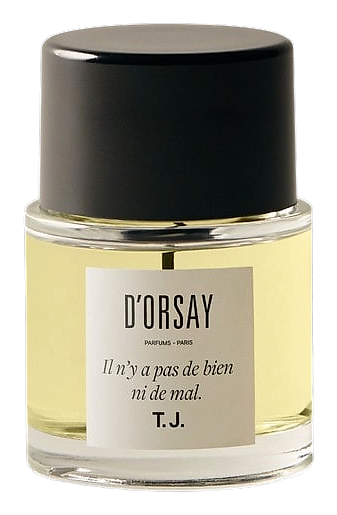
The name arrives first: Il N'y a Pas De Bien Ni De Mal. There is no good, there is no evil. A philosophical provocation from a house that has been asking such questions since 1830, when Count Alfred d'Orsay first commissioned a private fragrance for his lover. T.J. continues that tradition, a fragrance that refuses easy categories, named for a person who understands that some of the most interesting territory lies exactly between the light and the dark.
Amélie Bourgeois built this one around tension. Incense and resin on one side, danger, mystique, the kind of smoke that doesn't apologize. Vanilla on the other, the reminder that you can always come back from somewhere. The oud deepens the gamble. Damask rose adds a floral argument nobody asked for but everyone remembers. It's a composition that refuses to pick a side, and that refusal is the entire point.
The evolution
The opening lands resinous and immediate, frankincense and elemi arriving together, no polite greeting. Bergamot tries to lighten things for about ninety seconds before the smoke takes over entirely. French iris appears briefly, a powdery interruption that disappears as quickly as it arrived. By the heart, the oud has made itself known, smoky, medicinal, with geranium leaf adding a green sharpness that keeps the rose from going sweet. The base is where this fragrance earns its name. Labdanum and patchouli settle into something almost meditative, while Australian sandalwood and guaiac wood extend the drydown for hours. The vanilla doesn't save you, it just makes the darkness feel intentional. On fabric, the smoky trail persists until the next morning. On skin, plan for six hours minimum before it begins to quiet.
Cultural impact
In a market where 'unisex' often means 'sanitized,' Il N'y a Pas De Bien Ni De Mal commits to its contradictions. The incense-and-resin opening reads as confrontational to some, addictive to others, a dividing line that fragrance communities tend to discuss with unusual intensity. The vanilla drydown provides the reconciliation, the way back, which is perhaps why wearers who stay with it describe it as a complete narrative rather than a series of phases.