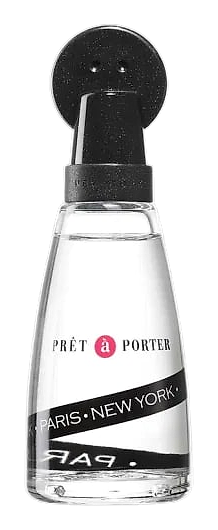

The Story
Why it exists.
The beginning
The term itself says everything. Pret à Porter, ready-to-wear, offered an alternative to custom salons and haute couture exclusivity. The idea was simple: consider the wardrobe, not the costume. Coty launched this fragrance in 1996 with that same principle in mind. A scent that reads as considered, not effortful. The woman who wears it has already made her choices. She just needs the fragrance to match. You don't smell this and think someday. You smell it and think right now. The scent itself is the statement. Confidence without announcement. A composition that arrives on its own terms, designed for the woman who already knows who she is.
The structure itself tells the story differently than most 90s releases. Tamarind, less common than tangerine or passion fruit, gives the citrus opening a tart, slightly fermented edge that most mainstream compositions skip entirely. It behaves like citrus but reads stranger, more interesting. The pink grapefruit isn't a placeholder; it's the foundation of the whole thing. Oakmoss does the heavy lifting in the drydown. Not patchouli, not vanilla, the material that defined chypres since 1917. A nod to Coty's own heritage, quietly anchoring a fragrance that otherwise reads as modern and accessible.
The evolution
The opening hits within seconds. Pink grapefruit, orange, violet leaf, a sharp, clear chord that announces immediately. Nothing tentative about it. This is a fragrance with nothing to prove. The transition to the heart unfolds naturally. Freesia and magnolia bloom against a backdrop of black pepper and cardamom, the florals don't soften so much as warm up, finding their footing alongside the spice. Nutmeg lingers in the distance, adding an aromatic green quality that keeps the heart from settling into pure sweetness. As the fragrance develops, the oakmoss and sandalwood arrive. Not dramatically. This is not a fragrance that announces its base. It simply becomes more intimate, the sillage recedes, the composition tightens, and what you are left with is a quiet warmth against the skin. Sandalwood's creamy woodiness, oakmoss's earthy undertone.
Cultural impact
Pret à Porter found its audience among women who understood fashion without needing to announce it. The kind of wearer who knows what the term means and does not need to explain it. It earned a quiet loyalty from those who appreciated its restrained confidence. Discontinued now, it persists through community reviews and collector interest. A scent that aged without becoming nostalgic, that remains relevant to anyone who values composition over trend. The fragrance speaks to an idea of sophistication that does not require validation.