The Story
Why it exists.
The beginning
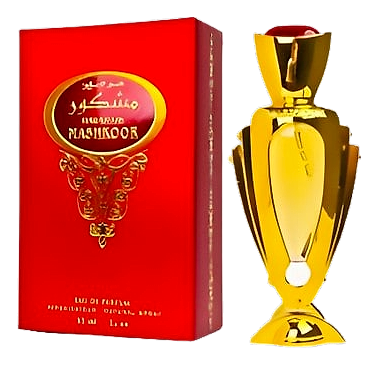
Mashkoor arrives from Al Haramain's atelier as a statement about sweetness and femininity, a different angle on what the house does best. The composition opens with almond bringing a marzipan-like sweetness, a slight bitterness underneath that keeps it interesting. Mandarin adds brightness, a citrus lift that cuts through the confectionery warmth without diminishing it. Then the florals arrive: peony, orchid, white lily in a layered heart that doesn't thin out or disappear. The florals are plush and immediate, their presence felt rather than hinted at. This is not a subtle fragrance. It announces itself, then stays for the duration, its sweetness and florals holding steady on skin. Mashkoor is approachable, bright, and feminine without apology.
The note structure of Mashkoor tells a story in three acts. First: almond, poppy, mandarin. The almond is the star, nutty, slightly bitter, with a warmth that feels edible. Poppy adds a subtle green undertone that prevents the sweetness from becoming cloying. Mandarin keeps things sharp at the opening, a burst of citrus that cuts through before the florals arrive. Second: the heart. Peony, orchid, white lily. These three white florals layer together to create something fuller than any single note would achieve. Peony brings its signature powdery-pink quality. Orchid adds a creamy, tropical depth. White lily keeps things green and translucent.
The evolution
The opening hits first with almond's marzipan warmth, sweet, slightly bitter, immediately distinctive. Mandarin arrives alongside, adding a citrus brightness that prevents the sweetness from settling too heavily. Poppy lingers in the background, a subtle green counterpoint that keeps things grounded before the transition begins. Then the white flowers arrive. Peony, orchid, white lily, they don't compete with each other, they layer. The effect is a floral heart that feels full and continuous, not a sequence of notes taking turns. Peony brings its rosy, slightly green floral character while orchid adds a creamy, exotic nuance. White lily contributes a classic floral sweetness that grounds the other two, the three working together to create a heart that feels cohesive and sustained. The florals soften slightly as they warm against the skin, but they don't disappear.
Cultural impact
Mashkoor offers something different within oriental florals: a feminine composition built around white florals and almond that feels substantial without relying on the darker woods often associated with this style. The fragrance speaks to a tradition where scent carries cultural weight beyond simple pleasure, where wearing a particular fragrance means something. The white florals take the lead here, their clean petal sweetness paired with the nutty warmth of almond rather than the resinous depths of oud. The result is a fragrance that makes its presence known.
The House
Al Haramain PerfumesAl Haramain Perfumes is a fragrance house rooted in Mecca, Saudi Arabia, with over five decades of experience crafting oriental perfumes. The company traces its origins to 1970, when founder Kazi Abdul Haque, a Bangladeshi businessman, began trading perfumes with shops in Makkah and Madinah before moving into production. Today, the business operates from the UAE under the leadership of Haque's eldest son, Mahtabur Rahman, who serves as Chairman and Managing Director. Al Haramain has built a portfolio that reportedly exceeds 1,000 fragrance variants, spanning pure perfume oils, concentrated sprays, bakhoor, and agarwood products. The brand maintains retail presence across the GCC, Middle East, Asia, and Europe through a network of exclusive stores. Notable releases include Dehnal Oudh Mahabbah from 2012, Red African from 2017, Mukhamria Maliki Silver from 2021, and the Musk Orchid and Musk Floral releases of 2023.
The Creator
IriniThose who have encountered her work describe a signature restraint with moments of surprising depth. She appears to favor transparent, skin-like materials that blur the line between perfume and atmosphere.