
The Story
Why it exists.
The beginning
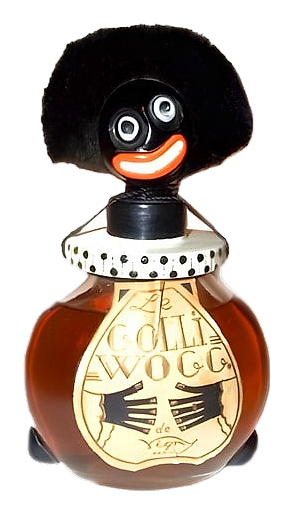
Jacques Vogel named Le Golliwogg for a character already controversial in 1919, a Black caricature from children's literature that had become a widespread toy and advertising motif by the early 20th century. By modern standards, the name is indefensible. What survives from Vogel's 1919 vision is the fragrance itself: an aldehydic oriental that opens with aldehydes and citrus, blooms into a dense floral heart, and anchors in a warm animalic base. The aldehydes lend a waxy, effervescent quality, almost champagne-like, while the citrus adds brightness to the opening. The floral heart unfolds with tropical richness and powdery softness, and the base settles into warmth with animalic depth that lingers close to the skin.
The aldehyde choice in 1919 was a statement. These synthetic materials carry a waxy, effervescent quality that feels almost champagne-like on first encounter. In Le Golliwogg, the aldehydes open the composition with an immediate effect: a bright, almost abstract top note that doesn't quite smell like any single flower. Below that, the heart is dense and classic, ylang-ylang providing tropical richness, violet lending its signature powder stroke, jasmine adding cream, and rose bringing complexity that shifts with warmth.
The evolution
The aldehydes announce themselves without apology, waxy, champagne-bright, almost sharp against the skin. Citrus arrives to sharpen the edges, then clove's warmth blends into the composition before the florals fully unfold. The heart is where patience pays off. Ylang-ylang opens the floral progression with tropical depth, then violet's powder softens everything, jasmine adds richness, and rose lingers underneath, shifting character as skin temperature rises. Lily of the valley contributes a green note that keeps the florals from becoming cloying. The base is where the composition truly reveals its character. Civet's animalic quality doesn't recede, it deepens, mixing with musk and amber into something warm and slightly unsettling. Vanilla and tonka bean soften the edges, while styrax adds a smoky-resinous quality.
Cultural impact
Le Golliwogg's name references a Black caricature from 19th-century children's literature that had become a widespread toy and advertising motif, now recognized as racist and discriminatory. That's the history. The fragrance itself is a 1919 aldehydic oriental, with aldehydes up front, heavy florals in the heart, warm animalic base below. These were abstract, bold compositions unlike anything nature offered alone. The aldehydic floral genre to which Le Golliwogg belongs represents an era of ambition in French perfumery.