
The Story
Why it exists.
The beginning
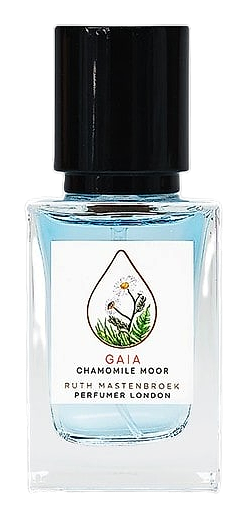
Gaia came to life in 2022, the same year Ruth Mastenbroek kept returning to one image: the moors of the Norfolk Broads at rest. Not the dramatic version, not the windswept romantic. The still one. Where chamomile grows at the water's edge and nothing is being asked of the landscape. The brief she gave herself was simple, bottle that exhale. The urge wasn't to prove anything. It was to write something quiet, something that captures the herbal stillness of chamomile blooming where land meets water, the kind of green calm that doesn't ask for attention. There's a particular quality to chamomile in its natural habitat, slightly bitter, slightly sweet, carrying that tea-like warmth that feels more like a held breath than a statement.
The choice to anchor Gaia in Roman chamomile is a deliberate one. Chamomile in perfumery carries a specific weight: it reads both as tea-like calm and as a faintly bitter herbal edge, the kind most green fragrances paper over with sweetness. Pairing it with palisander rosewood in the top is unusual, and that unusualness does the work. The rosewood brings a warmth chamomile usually lacks on its own, something woody and faintly sweet that softens what might otherwise read as austere.
The evolution
Bergamot pushes forward with a brisk, unsweetened brightness, almost citric but with a dryness that keeps it from reading sharp. Rosemary moves underneath, herbaceous and slightly camphorous, pulling the opening in a greener direction. Palisander rosewood softens the edges, adding a warm wood note that feels architectural rather than sweet. Then chamomile steps in and the whole opening reorganizes around it. The Roman chamomile has a particular clarity, tea-like and faintly bitter, anchored by the green tea that keeps everything transparent. Freesia adds a clean floral light that flatters everything around it without dominating. Over time, the base is what you're wearing. White musk settles against skin with a clean, almost soapy warmth, never sharp, never synthetic. Tonka leans in just enough to sweeten the drydown without making it gourmand.
Cultural impact
Gaia sits where the brief isn't to impress but to settle. It reads as something to reach for when the day has already asked enough questions, the kind of scent that exists alongside rather than on top of. The restraint in its construction is the point, a refusal to compete where competition isn't welcome. People return to it precisely because it doesn't demand re-justification, it simply holds its shape and stays legible without raising its voice. In a landscape where so many launches chase spectacle, there's something quietly radical about a fragrance that chooses stillness.