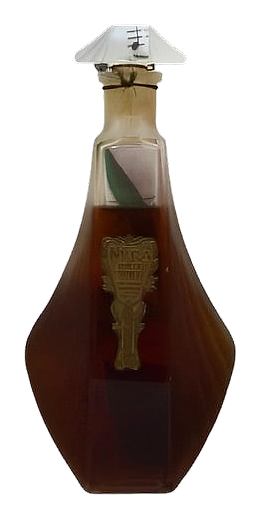

The Story
Why it exists.
The beginning
Nyra arrived in 1925, during a period of rapid change in American perfumery. Its name carries no documented public origin here, and no named perfumer is attached, so the safest portrait comes from what is known: a women’s eau de toilette launched in that era whose composition details have largely disappeared. The surviving record offers few fixed points and no verified note pyramid. Nyra can therefore be approached as a historical fragrance rather than a fully mapped modern composition, an object whose character is shaped as much by the distance between its documented launch and its discontinued status as by anything that can still be reconstructed today.
The available research gives Nyra a historical feminine identity but no surviving, source-verified note pyramid. That absence leaves room for a restrained floral impression without allowing a precise account of individual ingredients or their relationships. The documented 1925 launch and discontinued status give the fragrance the character of a lost reference point, while the limited surviving information keeps its interpretation open.
The evolution
Because Nyra's detailed note structure is not documented in the available sources, its evolution is best understood as a historical impression rather than a precise materials timeline. The record does not support a verified account of the opening, its middle phase, or the way the fragrance changes on skin over time. No documented trail or wear time is available, so any claim about projection, duration, or a particular sequence of notes would exceed the surviving evidence. Nyra is best considered through the limits of its record: a discontinued 1925 women’s eau de toilette whose original composition and behavior remain largely undocumented.
Cultural impact
Nyra’s documented cultural context is limited. It was launched in 1925 and later discontinued, but the available material does not establish its reception, sales history, influence, or relationship to a particular fragrance culture. Without those records, its cultural significance remains uncertain. The fragrance is best understood as a discontinued women’s eau de toilette associated with Richard Hudnut, with its larger historical meaning still open to research rather than defined by unsupported claims about advertising, retail distribution, or public response.