
The Story
Why it exists.
The beginning
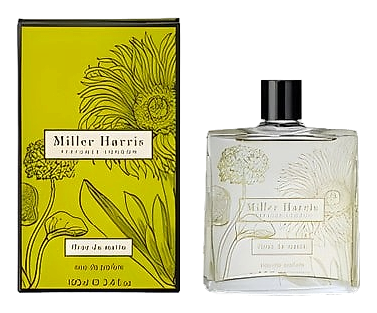
Fleur du Matin means flower of the morning, and that's not a metaphor. Lyn Harris built this fragrance around a specific hour on Porquerolles Island off the French Riviera, that narrow window just after dawn when the air is cool, the flowers are still wet with dew, and the day hasn't quite decided what it wants to be. Released in 2001 by the London house she founded, this was Miller Harris speaking in a voice the brand would return to again: precise, narrative, rooted in a single moment rather than an abstract idea. The island isn't a backdrop. It's the fragrance. Harris trained for five years in France before launching Miller Harris in 2000, and that French sensibility shows in how Fleur du Matin is structured, the way a green opening gives way to white florals that could only exist in warmth, the way the herbal notes never fully disappear even as the composition deepens. It's a fragrance that knows when to arrive and when to leave.
What makes Fleur du Matin unusual isn't any single material, it's the structural logic. The opening is aggressively green: galbanum and basil create an herbal sharpness that most perfumers would soften or bury. Instead, Harris lets it stand, using lemon leaf and grapefruit to give that greenness a cool, citrusy edge. The effect is immediate and slightly unexpected, like walking into a garden before the sun has had a chance to warm anything. The heart is where it softens without losing integrity. Honeysuckle, neroli, and jasmine arrive gradually, sweetness tempered by the still-present herbs beneath them.
The evolution
The opening announces itself without apology. Galbanum and basil hit first, green and immediate, followed quickly by the citrus bite of grapefruit and the crushed-leaf quality of lemon leaf. It smells like stems and morning, something alive and slightly raw. The transition happens within ten minutes as honeysuckle pushes through, its sweet nectar offset by the cool green notes still hanging on. Neroli and jasmine join, and suddenly the composition reads warmer, more floral, though the herbal backbone never fully disappears. By the second hour, the white florals have settled into the skin, their sweetness muted by the drydown of oakmoss and cedar. This is where Fleur du Matin becomes something quieter, a woody, mossy base that extends the florals' memory without overpowering them. The sillage drops to intimate by hour three, and what remains is a soft trace of cedar and jasmine that someone standing very close might notice. Lasted through a full workday in testing, though the final drydown becomes a skin scent rather than a room filler.
Cultural impact
Fleur du Matin arrived in 2001, a period when green fragrances were largely out of fashion. The early 2000s favored warm, sweet compositions, vanilla, amber, orientals dominated niche and mainstream releases alike. A fragrance built around galbanum, basil, and a green-floral heart represented a counter-programming choice that appealed to a specific wearer: someone who wanted complexity over comfort, specificity over safety. The 2014 relaunch suggested the original formula had advocates who never forgot it, a quiet vindication for a fragrance that never chased the mainstream.