
The Story
Why it exists.
The beginning
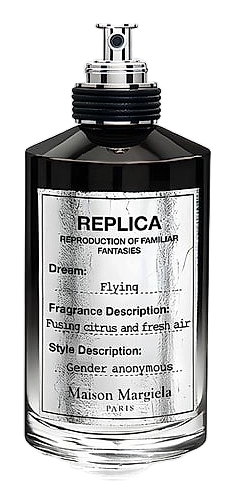
Maison Margiela's brief for Flying was a feeling, not a concept: the moment just before arrival. Not the drama of departure, not the exhaustion of transit, the anticipation of opening the gate. Perfumer Marie Salamagne built the brief into something wearable in 2016, translating the specific emotional register of that in-between moment into scent. The name came before the formula. Everything else followed.
Ozonic notes are a synthetic construction, they mimic the smell of air, at altitude, or near water. White florals like neroli and ylang-ylang bring warmth andcream. The tension between them is the point: something delicate and slightly distant, softened into something you can actually wear. It's a counterintuitive pairing that works because the ozonic accord here isn't aquatic or sharp. It's closer to the smell of recirculated cabin air, clean, pressurized, intimate rather than expansive.
The evolution
The opening is instantly bright, bergamot and petitgrain lifting the bitter orange blossom into something that reads as sky. That clarity lasts for thirty minutes before the neroli and ylang-ylang arrive, not a dramatic hand-off but a gradual accumulation, the florals layering over the citrus until you stop noticing the transition. The drydown is where Flying becomes itself. Moss and musk anchor the composition to skin, close and quiet. Projection drops after the first hour. By the end, it's something you smell on your own wrist rather than announce to a room. Six to eight hours, intimate to the last.
Cultural impact
Flying entered the market in 2016 during a transitional moment in travel culture, when flying itself still carried novelty and emotional weight, before the commodification of air travel accelerated. Maison Martin Margiela's Replica line had already established a framework for treating fragrance as conceptual art rather than status accessory, and Flying refined that thesis. The brand's decision to anchor a scent in the specific feeling of arrival rather than destination marked a departure from traditional fragrance marketing, which typically sells aspiration or desire. Instead, Flying sold an intimate emotional checkpoint, a moment of pause before re-entry into daily life.