
The Story
Why it exists.
The beginning
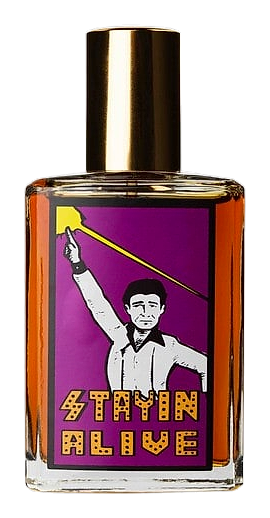
Stayin' Alive arrived from Simon Constantine's bench, and the name carries its own wink, a nod to the disco survival anthem, but the scent itself has nothing to do with sequins or strobe lights. What Constantine built here is a meditation on endurance, on what remains after the heat dies down. Frankincense, vetiver, sandalwood, vanilla. The architecture of stillness, dressed in smoke. The composition opens with a breath of cool brightness before the resins settle in, and there's a deliberateness to the construction that rewards slow attention. Nothing rushes to the surface. Each note arrives in its own time, layered rather than stacked, the way incense smoke curls in still air rather than firing off in a single burst.
The vetiver brings an earthy crackle, the sandalwood offers creamy scaffolding, and the frankincense does what frankincense has done for centuries: it sanctifies the space. Vanilla absolute anchors the whole thing in something edible, almost comforting, which keeps the smoke from drifting into territory that's more mortuary than meditative. The lemon in the upper register is a clever move, a thin blade of brightness that keeps the composition from suffocating in its own resin.
The evolution
The first spray is a bright crack, lemon zest over frankincense, almost astringent, like striking a match in a cold room. Within ten minutes the citrus folds back and the frankincense takes command, thick and church-like, hovering close to skin rather than announcing itself from across the room. The heart is smoke over warm wood, vetiver and sandalwood weaving together into something that smells less like a building material and more like the inside of a wooden chest that's held something precious for decades. Cinnamon appears as a whispered warmth, never sharp, more like the memory of heat than the thing itself. By the two-hour mark the composition has settled into its true register: a creamy, vanillic resin that sits on the collarbone and the inside of wrists like a second skin. The vanilla absolute is the survivor here. Hours later, when everything else has quieted, it remains, warm and slightly sweet, a final argument that the flame went out but the warmth didn't.
Cultural impact
Stayin' Alive occupies a specific corner of the Lush catalogue, the incense-and-resin territory where the brand does some of its most evocative work. Wearers tend to describe it less as a fragrance and more as an environment, something closer to a room than a personal scent. It's built for patience, for the wearer who treats scent as atmosphere rather than announcement. Within the brand's own lineup, it's the contemplative option, a composition that asks to be sat with rather than spritzed and forgotten.
The House
LushLush is a British cosmetics company founded in Poole, England, in 1994 by trichologist Mark Constantine, his wife Mo Constantine, and five additional co-founders. The brand gained international recognition for its hand-pressed bath bombs, which Mo Constantine invented in her garden shed in 1989. Now operating in 49 countries, Lush has evolved from a single High Street shop into a global retailer while maintaining its commitment to ethical manufacturing and cruelty-free products. In-house perfumers Mark Constantine OBE, Emma Vincent, and Alina Gliwinska create the brand's fine fragrances, which are presented through the Perfume Library concept stores in Liverpool, Florence, and London. The fragrance collection spans over 230 perfumes dating back to 1989, organized into thematic volumes that serve as milestones in the brand's perfumery history.
The Creator
Simon ConstantineSimon favors single‑note focus, often building a composition around a pure absolute or essential oil. He pairs a dominant material with subtle supporting accents, allowing the star ingredient to breathe.