The Story
Why it exists.
The beginning
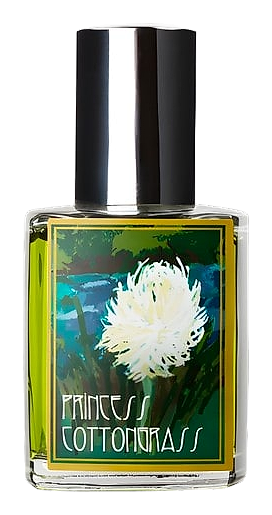
Princess Cottongrass is a composition by Mark Constantine and Simon Constantine, drawn from a Swedish fairy tale about a princess who waits by a forest lake, mourning the golden heart necklace she lost to the water. Cottongrass, the slender white tufted plant that watches over northern bogs, became her botanical stand-in. The Constantines translated that image into scent: violet leaf and nettle absolutes for the herbaceous green of the lakeside, neroli for the distant sweetness, pine for the character of the trees pressing in close. There's a quiet, Nordic kind of story in here, dressed in greens and the ghost of citrus blossom, the kind of fragrance that conjures cold water, pale plants, and a particular hush that falls over northern landscapes in the early hours.
Nettle absolute is the unusual choice here. It brings something rougher, more mineral than the usual green notes, with a faintly bitter edge that reads as actual soil and stem rather than stylized greenery. Paired with violet leaf, the two greens interact in ways that keep the composition from settling into a single mood. The neroli sits between them like a hinge, softening without smoothing things out entirely. It's a composition that earns its delicacy by refusing to behave delicately.
The evolution
The opening is sharp and resinous, almost medicinal, like breaking a green branch in cold air. That intensity softens relatively quickly. The neroli creeps in, not as a clear orange blossom but as something muddied and sweet, the way orange trees smell when the light is low. The violet leaf and nettle take over the middle hours, pushing the scent toward a damp, herbaceous green that borders on aquatic without ever going full marine. Canadian balsam shows up late, lending a quiet woodiness that keeps the drydown from dissolving into pure neroli sweetness. What remains after the fragrance has had time to settle is a skin-close trace of green woods and faded citrus, the memory of a forest after the rain has stopped. The transition from opening to heart happens gradually, without any single note announcing its departure.
Cultural impact
Princess Cottongrass occupies a particular place in Lush's fragrance library, a line that tends to frame each release as a narrative rather than a straightforward product. Its Swedish fairy-tale premise placed it among the brand's more conceptual offerings, and its green, almost bitter character has earned it a loyal following among those who prefer unusual compositions to safe crowd-pleasers. The Nordic setting, a princess mourning a lost necklace by a forest lake, gives the fragrance a mood that's rare in commercial perfumery: somber, atmospheric, rooted in landscape. That mood translates into a scent that doesn't aim for mass appeal.
The House
LushLush is a British cosmetics company founded in Poole, England, in 1994 by trichologist Mark Constantine, his wife Mo Constantine, and five additional co-founders. The brand gained international recognition for its hand-pressed bath bombs, which Mo Constantine invented in her garden shed in 1989. Now operating in 49 countries, Lush has evolved from a single High Street shop into a global retailer while maintaining its commitment to ethical manufacturing and cruelty-free products. In-house perfumers Mark Constantine OBE, Emma Vincent, and Alina Gliwinska create the brand's fine fragrances, which are presented through the Perfume Library concept stores in Liverpool, Florence, and London. The fragrance collection spans over 230 perfumes dating back to 1989, organized into thematic volumes that serve as milestones in the brand's perfumery history.
The Creator
Mark ConstantineConstantine's style resists easy categorization because he never formally trained within the classical French system. Instead, he developed what industry observers call a raw materials approach, favoring strong concentrations of recognizable ingredients over sophisticated mole…