The Story
Why it exists.
The beginning
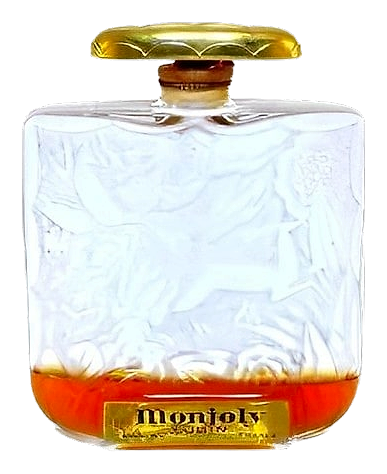
Monjoly appeared in 1927, carrying with it a quiet sort of confidence that fits squarely within the house's lineage of French fragrance. Pierre François Lubin created Eau de Chypre in 1821, the first of its kind, and the house has continued to bottle a particular kind of poise ever since, a poise that owes more to restraint than to spectacle. Into that tradition stepped Monjoly, a floral for women that bets firmly on softness. The name alone, a fold of syllables that sounds almost like a whispered endearment in French, sets the tone for everything that follows. Nothing here is loud. Monjoly was designed to be worn, not announced.
What makes Monjoly interesting is what it leaves out. Rather than chasing bold effects or dramatic flourishes, it pulls toward the powdery end of the floral spectrum, the kind of soft-focus composition that relies on quality raw materials doing their work without fanfare. The classic florals do their quiet work here, framed by a warm, slightly resinous base that gives the whole thing weight without darkening it. There is a deliberate gentleness to the construction, an unwillingness to compete for attention, and that restraint becomes its most distinguishing trait.
The evolution
Monjoly unfolds at its own tempo, never rushing, never demanding. The opening is a soft cloud of green and powder, with light florals underneath that read more like suggestion than statement, more atmosphere than announcement. Give it a few minutes and the texture begins to change: the powder deepens, the florals sharpen into something closer to the warmth of skin, and a faint haze starts to settle over the composition. There is a subtle transition in the hours that follow, a moment where the heart gives way to something drier and quieter, and the base notes begin to claim the composition for themselves. The later hours belong to a quiet blend of warmth and softness, a sweetness that flirts with comfort without ever tipping into anything heavy. The fragrance stays close rather than projecting outward, a quality that suits its overall character perfectly.
Cultural impact
Monjoly belongs to a particular Parisian moment, a product of an era when powdery, restrained florals carried genuine prestige among those who knew the genre best. Its production has been discontinued, which places it in the rarefied circle of vintage florals that collectors and devotees tend to seek out and romanticize. It is not a widely known classic in the mainstream sense, but for the audience that already loves soft-focus perfumery, the iris-driven compositions, the aldehyde bouquets, the powdery florals of the early twentieth century, Monjoly represents something quietly compelling. It carries the texture of its era in every facet.