
The Story
Why it exists.
The beginning
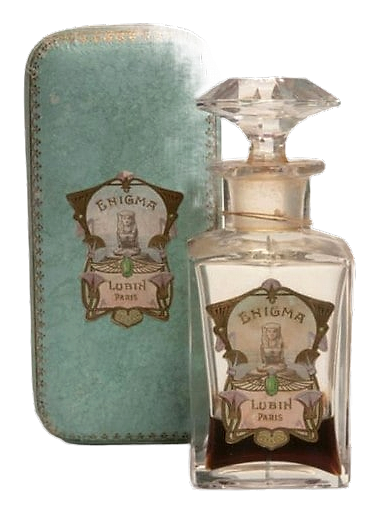
Enigma is a composition from Lubin, a house with roots stretching back into the late nineteenth century. The fragrance was first released in 1898 and repackaged in 1921, placing it firmly within a long tradition of perfumery rather than among recent debuts. Its age gives it a particular kind of authority, the kind that comes from surviving decades of changing tastes without disappearing entirely. What the juice itself offers is a direct, unapologetic blast of orange, described by those who have encountered it as super sweet and fresh, purely fruity with no florals to complicate the picture. That simplicity is the whole point. Enigma does not try to negotiate between freshness and warmth, or between clean and resinous.
The single-mindedness of Enigma is what defines it. Where many fragrances build a negotiation between top and base, layering complexity to keep the wearer guessing, this one keeps its attention on the fruit from first spray to final fade. There is no pepper turning the citrus into something savory. There is no soapy aldehyde stage where the scent pretends to be clean laundry. There is no transition from fresh to warm that gives the composition a narrative arc. What there is, instead, is consistency. The orange arrives whole and stays whole, a sustained note rather than a passing impression.
The evolution
From the moment Enigma touches skin, the orange announces itself with the kind of sweetness that has no interest in being subtle. The opening is sugary, almost candied, and it carries that intensity for longer than many citrus openings manage. This is not a fragrance that disappears in the first ten minutes. The fruit holds its shape, refusing to collapse into a generic bright sourness, and instead keeps its rounded, confectionary character visible throughout the early hours. As the composition wears, the sweetness softens but never fully leaves. The orange gradually loses some of its initial sharpness and settles into a warmer, almost jam-like impression, though it never tips into the territory of cooked fruit or pastry. There is no floral interlude to mark a heart phase, no soapy aldehyde pivot, no moment where the composition changes personality entirely.
Cultural impact
Enigma occupies a specific corner of the fragrance world, the one devoted to pure, unembellished fruit. In a market saturated with compositions that layer multiple note families and try to tell a story with every phase, a fragrance that commits entirely to a single character reads as either refreshingly honest or stubbornly limited, depending on the wearer. The orange note here is the kind that works well in warm weather, where bright citrus feels appropriate, and where the sweetness can lift rather than weigh down.